The Back Four: Idaho intro
On Boise, the Super League, and Championship stats

Welcome in to The Back Four!
As always, visit Backheeled for more USL content, including deep dives into all things Championship and League One. Also, listen to This League! and The USL Show to catch up in podcast form.
Without further ado, let’s get to it.
Boise in possession
To quote my own League One column:
Boise ultimately completed 577 passes, the most of any club in League One or the Championship in this calendar year...[and] their best sequences of the match usually featured a defender like Moussa Ndiaye or Jake Dengler skipping multiple lines, often liberating Blake Bodily to do damage from the left wingback spot in the process.
Nate Miller has his Boise team humming already, re-creating some of the best tendencies we saw during his reign in San Diego. While that possessive dominance out of an adaptable 3-4-3 didn't let Boise beat Spokane over the weekend, it produced some very pretty soccer.
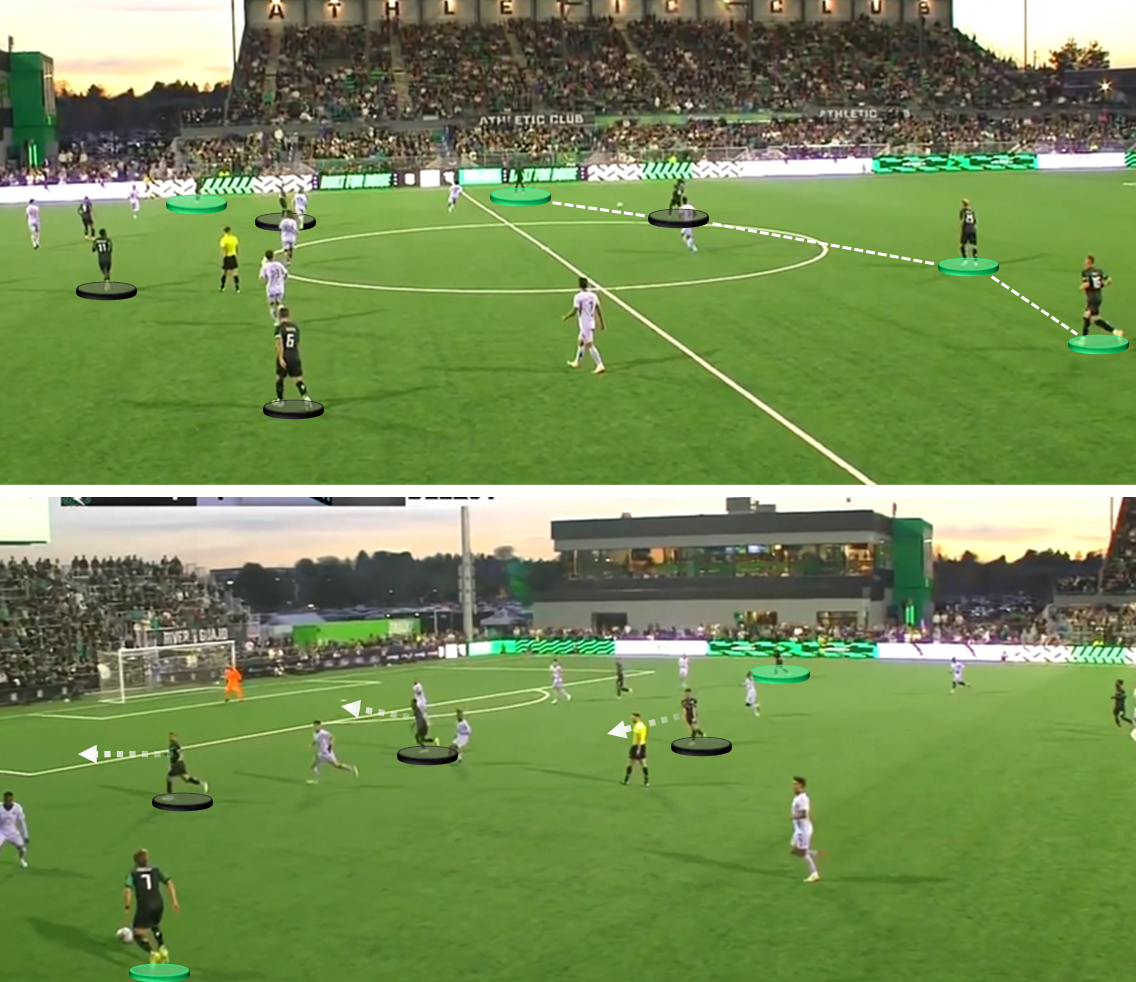
Here. you see a typical Boise possession broken down into two key frames. More often than not, midfielder Phillip Mayaka dropped to the level of the back three. He ended up with 93 touches and 83 pass attempts, only seven of which went long.
Miller rotated his back line with possessive dominance in mind, changing out regular starter Jonathan Ricketts for Moussa Ndiaye – who’s operated as a No. 8 for most of 2026 – at the right-sided center back spot. Ndiaye played there in college, but he provides a center mid’s sensibility as compared to the bolder Ricketts. That choice gave Boise four capable passers in the testing base of their 3-1-5-1, with the intention to pull Spokane’s organized 4-4-2 out of shape.
Upfield in that first frame, you see Boise’s three higher midfielders (Charlie Adams, Tumi Moshobane, and Denys Kostyshyn) spreading from halfspace to halfspace, flanked by elevated wingbacks. Nick Moon is seen on the right in the first frame; in the second, left-sided Blake Bodily has received at the sideline and triggered his teammates into motion as a result.
By using the gravity of their 3-1-5-1’s back end to open space, Boise could find Bodily and start to push forward. The wingback has options. Adams curls toward the corner as a potential crosser; Moshobane could shoot after receiving on a through. Centrally, Kostyshyn presents himself for a safer cutback. Constant motion like this defined Boise all throughout their Week 5 home opener.
Boise didn’t struggle to use those patterns to penetrate the Velocity’s lines. With 34 box touches, Miller and co. generated the third-most box activity of any team in a League One match this season. However, it took 5.2 final-third passes to generate one box touch on average – below the division’s median of 5.1.
I’m obviously not saying Boise was bad, but they could occasionally get bogged down. To my eye, Boise’s sharpest moves were also their quickest. The example above illustrates what I mean. There, Ndiaye hits a long pass upfield that actually falls incomplete, but the “keep three No. 8s high upfield” phenomenon allows for instant counterpressure and an advanced recovery. Suddenly, the midfielders can work side to side until Bodily is open to provide a lethal cross.
The best things come in moderation. Boise wouldn’t be Boise (and Miller wouldn’t be Miller!) if constant long balls were the order of the day. That said, a little bit more tempo and verticality could do wonders for a Boise side that’s 90% of the way there.
San Antonio and the recovery landscape
I’ve linked to Jamon Moore’s Backheeled piece on duels, recoveries, and success a few times, and that’s for good reason. The idea that winning loose balls more often than your opponent is a good trait is intuitive! After about a month of USL Championship play, recovery margin can provide a useful framework to check in across the league.
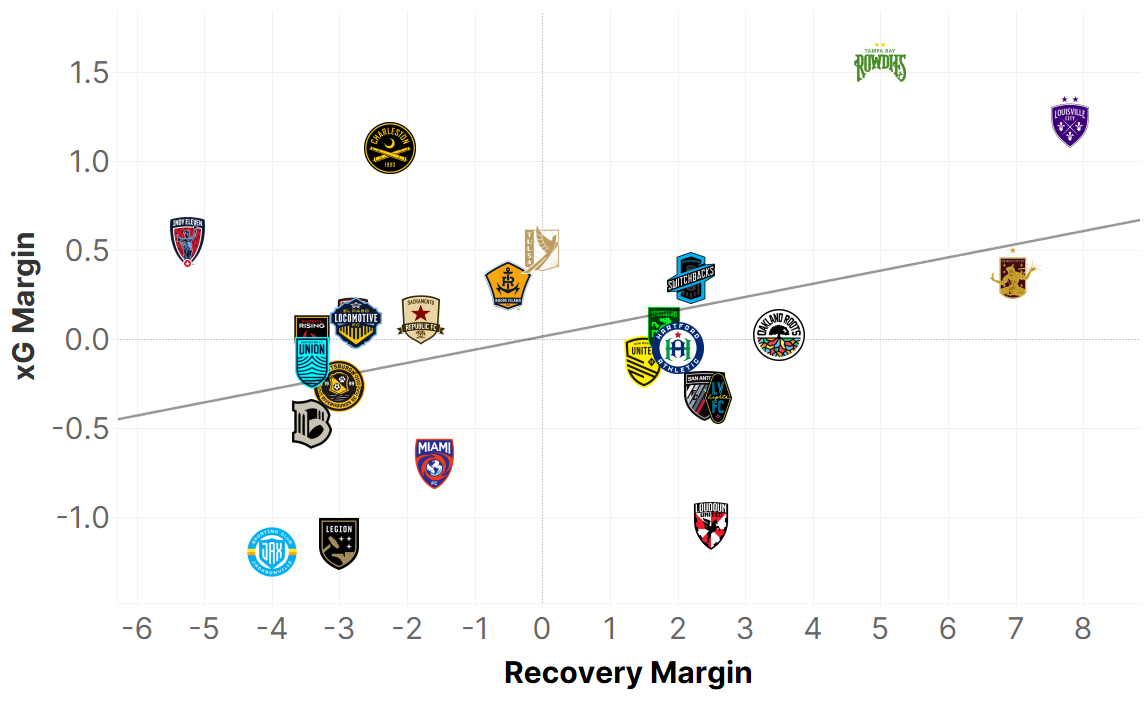
Recoveries aren’t everything, but you’ve already begun to see a linkage develop between team xG and that ability to reclaim possession. Particularly at the high (think Louisville or Tampa Bay) and low (Jacksonville and Brooklyn) ends, teams that are better in terms of recoveries are generating better expected results.
Even so, there are exceptions. Charleston has been below water in recovery situations but lit up the xG numbers; Indy is in a similar neighborhood, though the extremity of their long-ball style creates quirks. On the opposite side, clubs like Oakland and San Antonio have been able to regain on the regular without generating great xG numbers.
San Antonio is especially fascinating, and they show how a small sample size can skew the numbers. This team is, without a doubt, structured to recover the ball in useful places – they’re a top-five recovery team in the USL for a reason! At the same time, they’ve spent 162 minutes leading and none trailing this year, all without having earned a penalty; those things can drag down your xG margin within a five-game sample.
So far this season, Carlos Llamosa’s side ranks sixth for final-third recoveries per 90 minutes. They’re excellent at building in a 3-4-3 shape, patiently passing it around the back, and then breaking lines into the attacking zone. If that leads to a completion into someone like Jorge Hernandez, that’s great. If it leads to an incompletion that requires counterpressure and creates an advanced recovery, it’s equally useful.
Here, that latter scenario plays out. SAFC starts with an entry pass from center back Alexis Souahy into midfielder Curt Calov, who turns and sees options developing upfield. Calov’s lofted ball toward wingback Nelson Flores Blanco falls incomplete, but San Antonio is ready to clamp down.
As the wingback steps, left-sided center back Danny Barbir does the same and prevents opposing Monterey from making a clean recovery. You see that pattern broken down, with the lines of San Antonio’s 3-4-3 – defense in white, midfield in black, attack in red – completely intermingled. Barbir is so high, and it changes the play for SAFC.
As a result of that overloading, Llamosa’s side can keep possession and work centrally after the recovery. Christian Sorto tucks in from the No. 10 spot to facilitate, and multiple runners push over the top. If not for a dodgy first touch on the end of Sorto’s through, SAFC would be in on goal.
This sort of play is the stock and trade of clubs like Louisville City, who dominate the recovery numbers year-in and year-out on the back of big switches toward their wingbacks. Charleston is a different flavor of the same idea; they’re best when they can skip lines into the channels, with their No. 6s probing as recovery machines.
I don’t know if San Antonio is intentionally aping those ideas, but they’re producing the outcomes you want to see in loose-ball situations. That isn’t a one-size-fits-all route to success, but it pairs with SAFC’s tremendous “eye test” performances to explain why they’re atop the West after Week 5.
Super League Grab Bag
After downing Brooklyn a weekend ago, Lexington was in action again on Wednesday night in the nation’s capital. Despite playing on short rest, LSC showed off the varied attacking game that’s defined their success all season long.
DC Power’s press tended to take on a 5-1-2-2 shape (or thereabouts) with a focus on marking Taylor Aylmer and Nicole Vernis through the LSC pivot. Using a relatively high back line on top of that central denial, the hosts hoped to disrupt Kosuke Kimura’s side in possession. Lexington’s response was layered; long passes into Catherine Barry (who went 8/11 in the air) created a direct threat, while a blend of three- and four-at-the-back shapes tested DC’s organization.
Beyond those offensive patterns – which we’ll cover in a second – this was a match where Lexington was able to control the flow of play through possession. LSC held 53% of the ball and took less final-third touches than DC, but they completely controlled the tempo and kept danger well outside their box. Power ended up with just 0.99 xG, generating no open-play chances worth more than 0.10 xG individually.
You get two flavors of Lexington’s possession game here. In the first, Kimura’s baseline 4-4-2 shifts into more of a 3-5-2, with left back Ally Brown sitting deep and right back Alyssa Bourgeois pushing up the right. The result is twofold: Lexington’s three center backs and two center mids create a plus-one advantage against the front end of the DC press, while Bourgeois and forward-winger Hannah Johnson double up on Power’s left wingback.
Each of those overloads pays off. Center back Hannah Sharts can hit a pass into the midfield because of the deeper advantage, while DC’s back line has to overcorrect against the Johnson-Bourgeois further ahead. Because of that rotation, winger McKenzie Weinert becomes available up the channel while running against the momentum of the defense. Weinert is able to create a shot as a crosser shortly thereafter.
The second play is spiritually similar, relying on the technical skills of LSC’s defenders and the interchangeability of their attackers. Lexington is closer to 4-4-2 mode here, and it’s Brown setting the table from the left back spot at the start of the play.
Here, Brown and low-seated winger Sarah Griffith work with one another through the halfspace, whilst Barry also drops low from the striker spot. Meanwhile, Johnson sticks tight to the sideline as LSC create a four-woman overload in a tight space. Again, DC has to react. One of their center backs chases Griffith, and their right wingback is pinned between Johnson and Brown. Another ambitious through ball ensues, setting up Johnson for her game-winning assist.
No other team in the Super League this side of Jacksonville is as capable of working through tight spaces and keeping defenses on a string. Lexington has grown over the course of the year and especially since Kimura took over, and it’s kept them firmly in the USL title conversation.
Tampa Bay is probably out of that same conversation, but they used their own tactical innovations to down Dallas at midweek and, thus, cement their first back-to-back winning streak of the 2025-2026 campaign. Denise Schilte-Brown didn't necessarily change her formation on paper, but her choice to shift into a narrow 4-2-2-2 was vital at the Cotton Bowl.
What happened in the #GainbridgeSuperLeague in midweek? @tampabaysunfc.bsky.social took its first victory at the Cotton Bowl in club history, defeating Dallas Trinity FC for its second consecutive win on the road overall. Full Highlights -> www.youtube.com/watch?v=5cus...
— Nicholas Murray (@njemurray.bsky.social) 2026-04-02T12:58:49.224Z
The Sun's shape could vary, but it was predicated on Sydny Nasello and a partner – usually natural No. 6 Jordyn Listro – marking the members of the Trinity pivot. Tampa Bay did extremely well to shift from side to side as a connected unit, pinning Dallas at the sidelines and then allowing their fullbacks (Sabrina McNeill and Victoria Haugen) to trap.
The same narrowness didn’t necessarily lead to bountiful chances, and it limited the open space Nasello could find. At the same time, Tampa Bay’s 4-2-2-2 let McNeill and Haugen maximize their impact ip the flanks. The fullbacks combined to take more than 120 touches and contest 20 one-on-one duels.
At no point was that dynamic clearer than in the run-up to Tampa Bay’s go-ahead 28th minute goal. There, McNeill rounded a corner and dribbled into the Trinity midfield. Taking up the position of a narrow No. 10 in the act, McNeill triggered forward Maddie Pokorny to rotate wide and maintain a sense of spatial balance. With Dallas caught in rotation, Pokorny could receive, cross to the far post, and let McNeill continue crashing toward the net to score.
On Sunday, the Carolina Ascent came to Tampa Bay ready to take advantage of the adjusted shape. The Ascent didn’t necessarily get away from their usual 4-4-2, but they had multiple ways to leverage the Sun alignment.
In some cases, Carolina would use deeper-seated wingers to draw the Tampa Bay fullbacks up and break lines beyond them. At other points, Carolina’s wingers would do the opposite thing, pushing extremely high to pin the Sun deep and prevent sideline trapping. That’s what you’re seeing above.
Initially, Tampa Bay is narrow as Carolina center back Jenna Butler possesses; the goal is to deny an entry pass into the pivot. Instead, Butler swings the ball up the channel to advancing right back Addisyn Merrick. You’d expect help to arrive, but it quickly becomes apparent that McNeill is held back by the presence of elevated winger Tyler Lussi.
Tampa Bay stays shapely through the middle, but all it takes is some one-on-one panache from Merrick to create a central break, wreak havoc, and push the Ascent into the box. Ultimately, Merrick and Jill Aguilera took 125 touches from the fullback spots and tied for team lead with 13 final-third passes apiece. Their ability to control the wide areas dimmed the Sun.
The close-but-no-cigar nature of Tampa Bay’s tactical changes is why they’ve struggled throughout the 2025-2026 season and why clubs like Lexington have flourished. At some point in a long USL season, “Plan A” is going to lose its luster. Title contenders are measured by their ability to find an answer – something that Schilte-Brown did last spring and Kimura seems to be doing now.
A play I liked
Sacramento’s attack has been decidedly eh in 2026. They’re putting up 1.25 xG to rank just below the Championship average; their shots on target and box touch numbers are similarly mid-table.
A win against Phoenix where the Republic put up just 0.8 xG won’t change hearts and minds, but I liked what I saw. Neill Collins’ three-at-the-back build shape – which, granted, could shift between a three and four setup – had Rising on a string and created sequences like this:
Here, you get a sense for that variability, with elbow-ish fullback Michel Benitez dropping low off the left off the three truer center backs. As he does so, Benitez forces one of Phoenix’s three center mids to track him upfield.
That run and reception bend the opposing midfield to open up a pocket of space, which Mark-Anthony Kaye (denoted in white as a member of the pivot) identifies. Kaye has been absolutely tremendous so far this season, and he’s able to find a touch, turn upfield, and play winger Dominik Wanner into the box in this instance.
The play doesn’t end there. After Phoenix gets a stop, they could be off to the races. Instead, Kaye and Benitez press the ball against the sidelines to unsettle the guests. Rising eventually play a pass upfield to a roving forward, but the margin of error is slim, and goalkeeper Danny Vitiello is able to snuff out the danger.
The defensive grit is classic Sacramento, but that ability to creatively drive through the midfield is something new. The more oxygen Kaye gets in open spaces, the better off the Republic attack is going to be.
In other news…
Sam Shashoua is taking 88 touches and attempting 22 final-third passes per 90 for Birmingham, and I think that’s beautiful. The midfielder looked good as a left-skewing No. 8 late last year in Mark Briggs’ 3-5-2ish shape, but he’s taking a leap in a freer system under Jay Heaps. The Legion are fun!
In “attendance numbers are performative” news, Jacksonville reported 8,978 fans as having attended their mid-afternoon Super League match on Saturday and 1,982 for their Championship match a few hours later. Maybe the good people of Jacksonville are locked into all things Ashlyn Puerta – who isn’t? – but that still feels odd.
An important and relatable post:
Thinking about Omar Ciss today.
— Kaylor Hodges - Hammering Down (@kaylorhodges.bsky.social) 2026-04-04T18:23:50.229Z
I saw the Jon Bernthal-led Dog Day Afternoon on Broadway, which I liked a lot despite fairly tepid reviews. The original film, directed by Sidney Lumet and starring Al Pacino, benefits from some of the best mise en scene in the history of film. That term basically describes how setting, production design, costuming, and the like contribute to the vibe of a movie. In the same vein as Do the Right Thing, Dog Day Afternoon is the cinematic embodiment of “hot New York summer day,” and you just can’t get that same feeling on stage.
And finally: the streets are saying Darth Maul is back.