The Back Four: Friendly fire
On Jacksonville's preseason, new-look Madison, and the Super League


Welcome in to The Back Four!
As always, visit Backheeled for more USL content, including a look at the Tormenta situation and a deep dive into the USL's youth movement. Also, check out This League! as we continue to preview the 2026 season.
Without further ado, let’s get to it.
Overanalyzing a match that didn't actually count
We entered the preseason knowing less about Sporting Club Jacksonville than any other club in the USL Championship, but that began to change this weekend. Liam Fox’s side took on the Charleston Battery – themselves a new-look unit – in a preseason friendly that was (mercifully) streamed this Saturday.
The immediate takeaway? Jacksonville is going to be fast, pressureful, and direct. This is an extremely young roster, and Fox is using it to press in a 4-4-2, tighten the pitch with a high back line, and make life difficult for the opposition. That showed at Hodges Stadium over the weekend.
Do what you will with preseason performances, but Jacksonville looks like they're going to be *very* direct. The Sadlier-Luckhurst-AlQaq front line is giving Charleston fits as the sharp end of that spear.
— John Morrissey (@usltactics.com) 2026-02-21T22:37:01.692Z
Within 60 seconds of kickoff, Jacksonville used their verticality to put Charleston to the sword. Goalkeeper Christian Olivares went long, midfielder Jacob Evans made a central recovery and first-timed the ball back into the mixer, and winger Ahmad Al-Qaq pressed the Battery’s left back into trouble thereafter. In control, Al-Qaq was able to cross and force an own goal.
Broadly, Jacksonville built with long goal kicks or, failing that, one- or two-pass sequences through the back line that quickly resulted in a long ball. Upfield, a four-man attacking midfield of Kieran Sadlier, Evans, Zeke Soto, and Al-Qaq sat beneath striker Adam Luckhurst and lay waiting to press for recoveries in a possessive 4-1-4-1.
While Jacksonville could spray in either direction, their best moves leveraged Al-Qaq and Luckhurst’s existing relationships, carried over from their shared 2025 season in North Carolina. Off the left, Sadlier showed flashes as a go-it-lone shot creator in open space, but he also had a friendly matchup against a fullback in Douglas Martinez that’s still learning the ropes at that spot.
Meanwhile, Soto was a pest against his former club, providing zest in possession while also stepping up like a forward in the pressing 4-4-2. That positioning let the 19-year-old show off his defensive work rate, but it also rendered him Jacksonville’s best (and only?) controlled outlet in transition – a fact that Soto leveraged into a go-ahead counter in the friendly’s second half.
Watch Sporting play, and it’s immediately clear that Fox wants to control matches with aggression and athleticism. This team is going to tilt the pitch with long balls, close hard, and embolden an elevated back line to frustrate opponents.
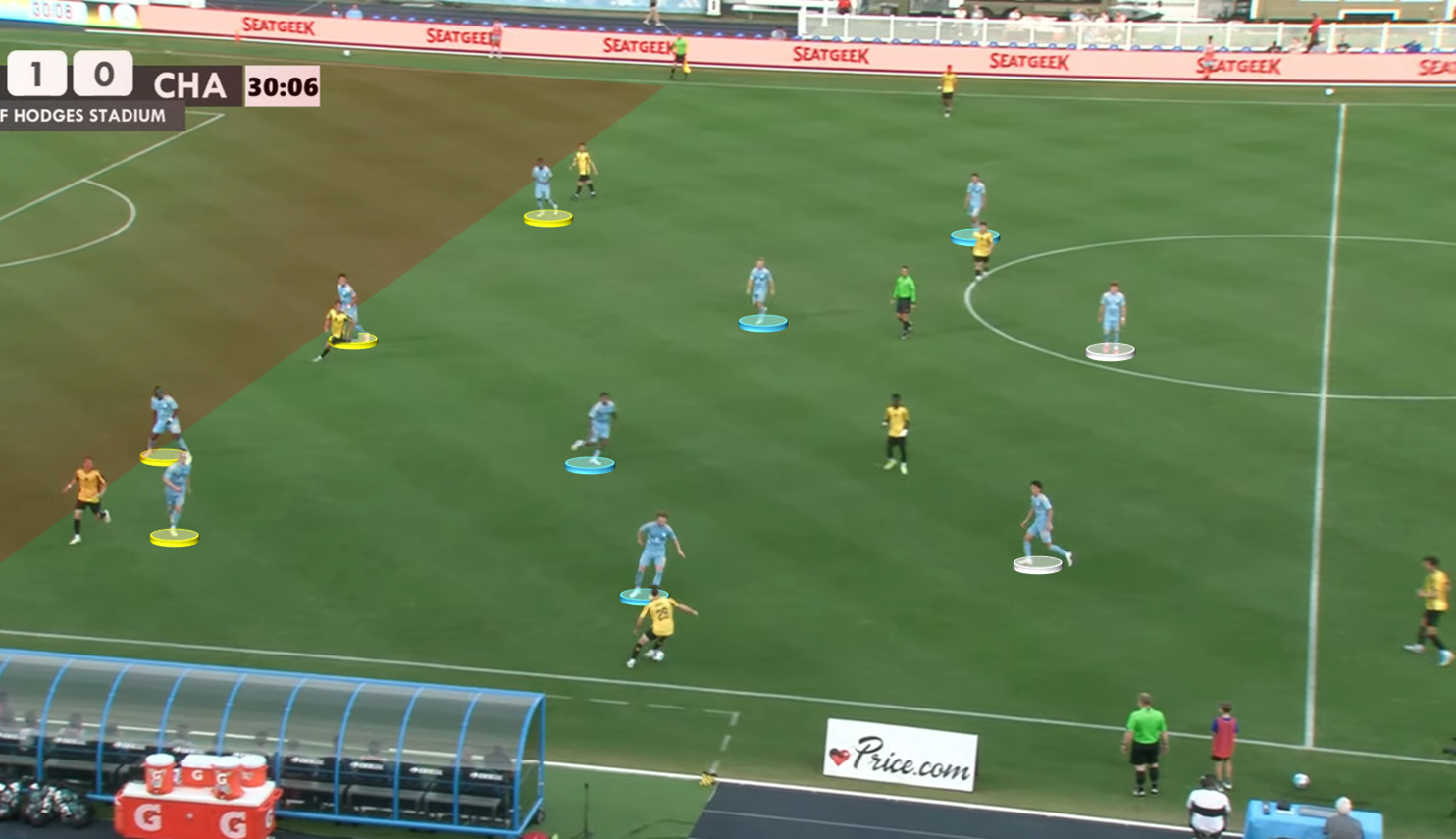
That’s visible here, where Jacksonville’s back four stays up even though the visitors have penetrated the attacking half. Against Charleston's short build, Jacksonville kept their defenders a step inside the opposing half; the high line prevailed in all phases.
For the Battery’s part, you’ll note a pseudo-back three above, and that was part of Ben Pirmann’s design. Charleston pressed in a 4-2-3-1 for the most part but showed far more flexibility in possession. In the frame, left-sided Jeremy Kelly has the ball nearer to halfway, whilst left back Nathan Messer is far above him – almost operating like a forward.
On the ball, the Battery had two flavors. The first (and less common) featured a true back four and a somewhat quicker, more vertical style. The second, which defined most of Charleston's offensive time, saw one of their No. 8s drop between the center backs into that aforementioned three-at-the-back look.
(Stray note: late in the match, Laurent Kissiedou became that deep center mid, while substitute Houssou Landry wrecked shop further upfield. I'm fascinated.)
Style #1 is seen in the first clip here, where defender Sean Suber tries to cheat a pass over the top toward forward Colton Swan. In hitting that chip, he forces Jacksonville's spine deep, drawing markers toward the streaking No. 9.
Thus, central midfielder Emilio Ycaza is in space to claim the second ball off of Sporting's meekly cleared header. Ycaza is a premium decision-maker in these sorts of situations, and he quickly tees up Kissiedou (the starting No. 10) to drive between the lines after the recovery.
More often, Charleston shifted into a possessive 3-1-5-1 or 3-4-3 which typically deployed Ycaza as that pass-first proxy central defender. As mentioned, Messer often made runs above the level of Kelly to become a third "forward" in terms of his positionality within that 3-4-3ish look; Wilmer Cabrera stayed high on the right as his complement. That wasn't the only choice, of course. The full-width 3-1-5-1 gave the Battery three central options from halfspace to halfspace, innately outnumbering the two-man Jacksonville pivot.
In clip #2, it's center back Graham Smith who does the hard work as an entry passer, finding Kelly at his feet on the half-turn in the halfspace. Immediately, Charleston draws the defense narrow and pings rightward into Kissiedou, Martinez, and an elevated Cabrera.
Both sequences are marked by indecision close to goal, but the build-up principles are locked in. Given that we’re still in February, I imagine Ben Pirmann will be happy with that sharpness – even if there’s room to grow defensively in the face of direct opposition. Credit to the home side as well; I thought left back Tyshawn Rose looked immaculate in one-on-ones despite often being the target of Charleston’s final-third activity.
My big takeaway? Jacksonville is going to be far, far better than my worst fears had anticipated. I’m always pessimistic in the face of uncertainty, so I’m feeling wildly more certain about Sporting Jax after Saturday’s friendly. Maybe the confidence is misplaced, but Fox has an astute sense for how to marry system and roster at Hodges Stadium.
Making Madison make sense
With each passing year, Forward Madison has grown more and more distinct in their style. 2023 saw this club finish with top-half pressing returns (see 3.6 final-third regains per 90) on top of majoritarian possession numbers. Since then, the 'Mingos have grown ever more controlling with the ball and ever less aggressive without it. In 2025, they finished with 1.9 final-third recoveries a match, 13% lower than any other team in League One history.
Matt Glaeser and co. have completely remade their roster this winter, but how much will that style change? That remains to be seen, but the new-look squad is built to evolve without the ball.
There are some cases where pressing statistics can tell disparate stories. In last year's USL Championship, for instance, Lexington ranked 18th in passes against per defensive action (10.3) but put in the sixth-highest defensive action height (43.0 yards) in the division. In other words, Lexington didn't lunge into challenges at first pass but set a hard line of confrontation closer to halfway.
Madison wasn't in that bucket. They didn't press high out of their 5-2-3 structure, and their average intervention came merely 38 yards upfield – one of the lowest marks in League One. Still, this offseason has centered around defensive pick-ups that are more willing to push upfield, maintain a mid-high line, and backstop a sharper pressing approach.
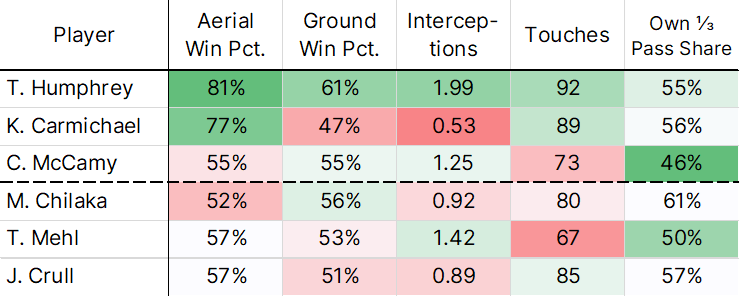
I’ve loosely mapped Collin McCamy, Kevin Carmichael, and Turner Humphrey as Madison’s back three going from left to right. That presumes Glaeser will stick to his usual 3-4-3, of course, but the center back position has been the Mingos’ primary point of recruiting strength over the winter.
When you consider those three additions against pieces like Timmy Mehl, Michael Chilaka, and Jake Crull from last season’s roster, the trends start to calcify. Judging by efficiency in ground duel situations, Humphrey and McCamy (cumulative 58% win rate) are superior one-on-one defenders and more willing passing-lane jumpers (66% more interceptions per 90) compared to their predecessors. In block, Carmichael and Humphrey are superior aerial battlers. At the same time, all three additions are comfortable as high-volume progressive passers; merely 51% of their passes ended in the defensive zone in their most recent full seasons.
That’s a long way of saying two things: this back line (1) will ably support high shares of possession while (2) giving Glaeser more defensive flexibility.
Given how Madison’s midfield pivot has evolved, that latter point gains even more importance. Recruits like Jackson Castro and Roman Torres can play the pivot, but they’re focused on progression first and foremost. Torres was a 97th percentile progressive passer out of the holding midfield while at Creighton; he was also listed at 5’11” and 145 pounds when he got loaned to Birmingham last year. A destroyer, he ain’t.
Castro profiles similarly, having split time between the left halfspace and pivot with Vancouver Whitecaps 2 last season. The 23-year-old has two-way upside after a campaign where he put up 2.5 tackles and 4.6 recoveries per 90 across nearly 2,500 total minutes, but it’s his control on the ball that stands out.
When Castro played the pivot, it often occurred in a system that defended like a 4-4-2 but curled up the left side into an offensive 3-2-5. That’s the framework in which Castro is operating above. While the midfielder is mostly right-footed, you see him hit a terrific left-footed pass toward the elevated fullback, instantly allowing Vancouver to combine through the channel and get into the final third. Castro, who loves to drift in front of his defense, receive under pressure, and dictate the tempo, is full of such moments.
You can watch that sequence and easily imagine Derek Gebhard – Madison’s only returning player – as the underlapping receiver with room to work around the 18-yard box. Plays like that will be the Mingos’ bread and butter if all goes to plan. When you pair the new progressive options at the No. 8 spots with the refreshed back line, things get really exciting; Madison will have an improved ability to take the ball away and instantly pass their way upfield against unready opponents.
Now, while the ideas are strong on paper, they aren’t guaranteed to click from day one. Madison is almost like an expansion team given their level of overhaul, and they’re figuring out how to operate with Matt Cairns and Glaeser as a sporting director/manager pair. I don’t want to call those factors “headwinds,” but they’re portentous of a feeling-out period.
There’s also the explicit recruitment strategy to contend with. Cairns came to Wisconsin from Huntsville in MLS Next Pro, and he’s added a number of familiar faces from that division to anchor Madison’s overhaul. I don’t think the difference in level between the two leagues is all that great, but that doesn’t mean the change-over will be a cinch.
In other words, the 2026 version of Forward Madison deserves some leeway. The ideas here are strong, and the changes to the club’s model are going to be highly beneficial in the long-term. Above all, this is a transition year. That could lead to instant contention; it’ll definitely lead to ups and downs in the opening months. If it all goes right, Glaeser and this Madison side have enough talent to make a genuine run at the playoffs.
Super League roundabout
You won’t get a weightier matchup than Lexington SC and Sporting Club Jacksonville in the Super League, and the two juggernauts lived up to expectations in their battle on Saturday. Much like LSC’s recent win over the Carolina Ascent, this was a game where quick line-breaking moves meant everything – only this time, they broke in the opposition’s favor.
Against Jacksonville‘s 3-5-2ish base attacking shape, Lexington tended to tilt their 4-4-2 to attain midfield parity. That mostly drove through right back Alyssa Bourgeois, who shifted up her side to stymie combination play between wingback Meg Hughes and star attacking midfielder Ashlyn Puerta. When LSC could slow Jacksonville down and then settle into a compact block, they mostly felt stable.
Stacey Balaam’s side was more outwardly aggressive without the ball, running with a 5-1-2-2 press that took risks. Up the middle, Jacksonville used their No. 8s as loose markers against the opposing pivot, keeping Sophia Jones lower as a holding mid that could address between-the-lines receivers. Jacksonville wanted to prevent those passes in the first place, so they also allowed their center backs to step and mark the opposing forwards.
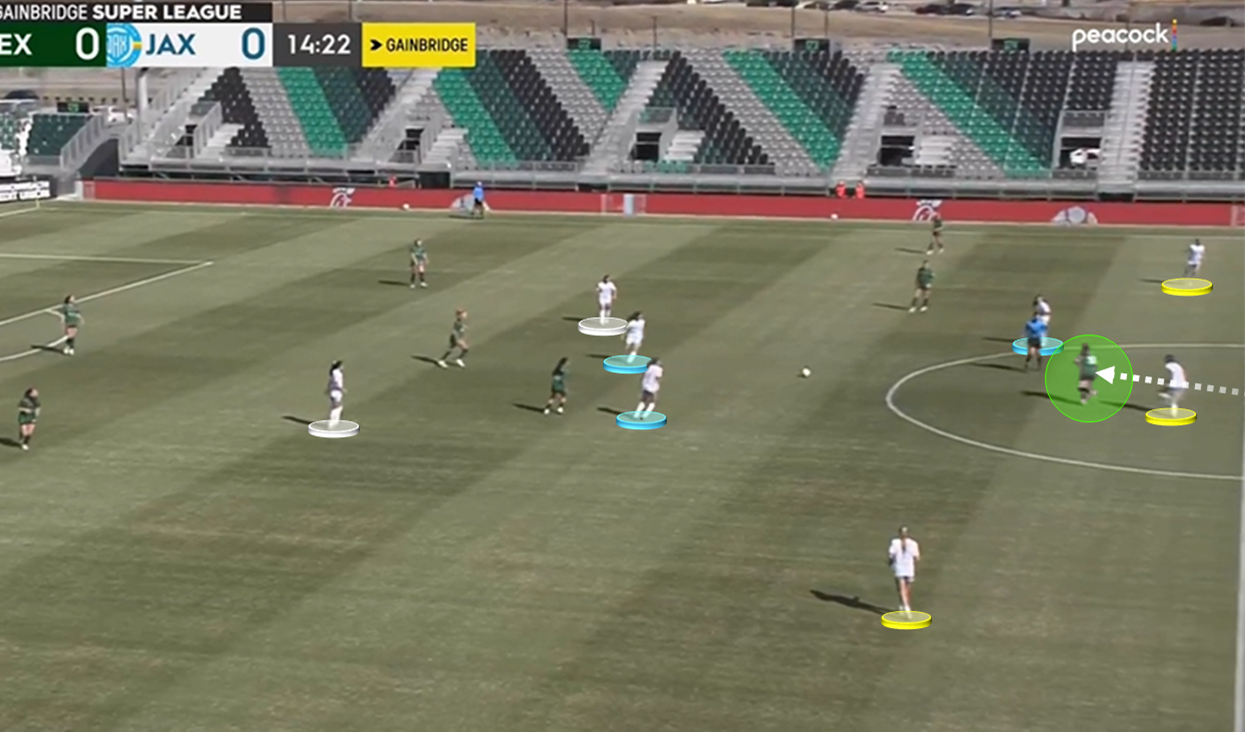
That rough setup is seen here, with Jacksonville’s forwards (white) and midfielders (blue) trying to clog central lanes. Here, a pass is already on the way toward Catherine Barry in Lexington’s attacking line, but she’s barely given room to breathe by center back Georgia Brown (yellow) on the step.
LSC found recourse in a few ways. For one, they tended to use Bourgeois like a third center back in possession, adopting a lopsided 3-4-3 with McKenzie Weinert as wingback-in-concept-only up the right. Still, that lean challenged Jacksonville’s two-man press and (theoretically) encouraged disorganization in rotation.
Often, Lexington let both Barry and Addie McCain drop in for touches; the presence of two No. 9s in low spaces could force central overreactions, thus allowing space to switch over the top. Positionally, winger Emina Ekic was LSC’s highest-placed player in the run of play – a one-woman pressure-release valve on the diagonal. Between her and Weinert on the opposite flank, Lexington found their best opportunities by goading Jacksonville narrow and then hitting sweeping passes toward the channels or sidelines.
Neither Ekic nor Weinert were consistent in beating the wide center backs, combining to go 7/15 in one-on-ones. While they helped Lexington find momentum in the first 30 minutes of Saturday’s match, that forward-tilting impetus eventually left the door open for Jacksonville to score.
Here, Lexington is advancing into the final third with Barry in a pocket position and Bourgeois having pushed upfield. However, when a pass into McCain is dislodged, there isn’t a sufficiently organized counterpress in place to stop a break.
It’s a testament to Jacksonville’s fluidity that center back Grace Phillpotts – whose primary role was shutting down Weinert on the edge of the 18-yard box – leads the way. Here, you see the defender dribble upfield before the hosts can find their shape. In front of Phillpotts, Puerta and the two strikers streak ahead to create a functional three-on-two. Ultimately, LSC will overcommit to those threats and leave themselves open to concede at the back post.
It’s that manner of dynamism that’s driven Jacksonville all year long, and it had them 2-0 up by the stroke of halftime at the weekend. Lexington certainly threw their share of jabs, but they didn’t have the haymaker that was needed to blow the match open and generate numerical superiority in transition. That’s a credit to Balaam and her wide center backs; Phillpotts and Julia Lester were simply sublime in this clash of the titans.
In Carolina, the Ascent gritted out a suffocating win against Dallas Trinity, and it was Sydney Studer's excellence that proved definitional. Admittedly, Studer’s headline contribution came in the attacking zone, where she scored in the 26th and 63rd minutes. Even so, the star center back's leadership in her natural position was every bit as crucial for Carolina.
By the time the Ascent went up 2-0, they held just 29% of the ball and conceded a 66% majority of the field tilt to visiting Dallas. This was far from a walk in the park; Nathan Thackeray’s Trinity were successful at shifting left back Cyera Hintzen high out of an off-ball back four and tilting into a 3-2-4-1 attack. Between the Hintzen/Chioma Ubogagu duo up the left and Lexi Missimo’s central brilliance, options abounded.
Phillip Poole answered in a few ways. For one, his 4-4-2 press was allowed to extend deep into the opposing zone, backstopped by a Studer-led defensive line that sat high to maintain compaction. That was a tightrope act all its own, and its success owed to terrific teamwide communication. By virtue of the press, Carolina limited Dallas’ ability to quickly swing into their preferred attacking shape.
Even in less organized moments, the Ascent could lean on their star center back to do the job. Here, Dallas is seen resetting around the halfway line, and they’re able to set up the Ubogagu/Hintzen partnership against a somewhat unprepared Carolina flank. An entry pass into the channel ensues, but Studer is there to cut it out without a second thought. This was one of 11(!) clearances she put in.
Later in the match, Dallas became more willing to hit longer balls toward substitute forward Bethany Balcer and lean into their second-ball grit. Again, Carolina’s structure stopped that gambit from really paying off, as did the fact that #12 went 5/6 in the air. Indeed, Studer was the beating heart of the defense, furthering her season-long average of 6.1 clearances and a USL-best 3.5 aerial wins per 90.
I’ve tended to harp on Carolina’s streaky offense, but that’s because the defense is so darn good. We know the Ascent press is elite, and we know that Studer will clean up danger in her own 18-yard box. Studer won't be dropping braces every week; Carolina is a consistent finisher away from really looking lethal.
In other news…
I wrote on the South Georgia Tormenta hiatus news as it broke this weekend, and while there’s a lot to digest relative to League One’s (potential) use of a dispersal draft and the bigger insights into the health of the USL model, I just want to underline that this situation sucks. It’s not fair to the players who need to find new work and relocate at the very last minute, nor is it fair to Mark McKeever and this coaching staff after a stellar end to 2025. It’s especially heartbreaking for Tormenta’s devoted fans.
I don’t think you can look at Tormenta and say that they did anything particularly wrong at an ownership level. Yes, there’ve been financial difficulties and false-start stadium endeavors, but this has largely been a well-run club by League One standards. Bringing a professional team to Statesboro was never going to be easy, but this is a miserable way to go.
Eyebrows firmly raised at San Antonio running a back three with Mitchell Taintor, Alex Crognale, and Santiago Suarez doing the business at the back. All three are very, very good initiating passers that fit this system – though I’m dubious of a 3-5-2 that leaves midfield zhuzh on the table as compared to a proper 3-4-3 with narrow No. 10s.
Love the Adam Armour pickup in Portland. While the left back isn’t a sure thing in the way Nathan Messer might’ve been, he’s got a legit professional track record spanning the USL, MLS, and the German lower leagues. As a teenager with the Charlotte Independence in 2021, he was good for a sterling 2.1 successful dribbles and 0.15 xA per 90; in a far more staid FC Tulsa system two years later, he won 6.5 duels per game. Armour’s two-way upside is undeniable.
For the absolute sickos – and it might just be me! – with an interest in Jacksonville's rotation on Saturday, I present you with a graphic:
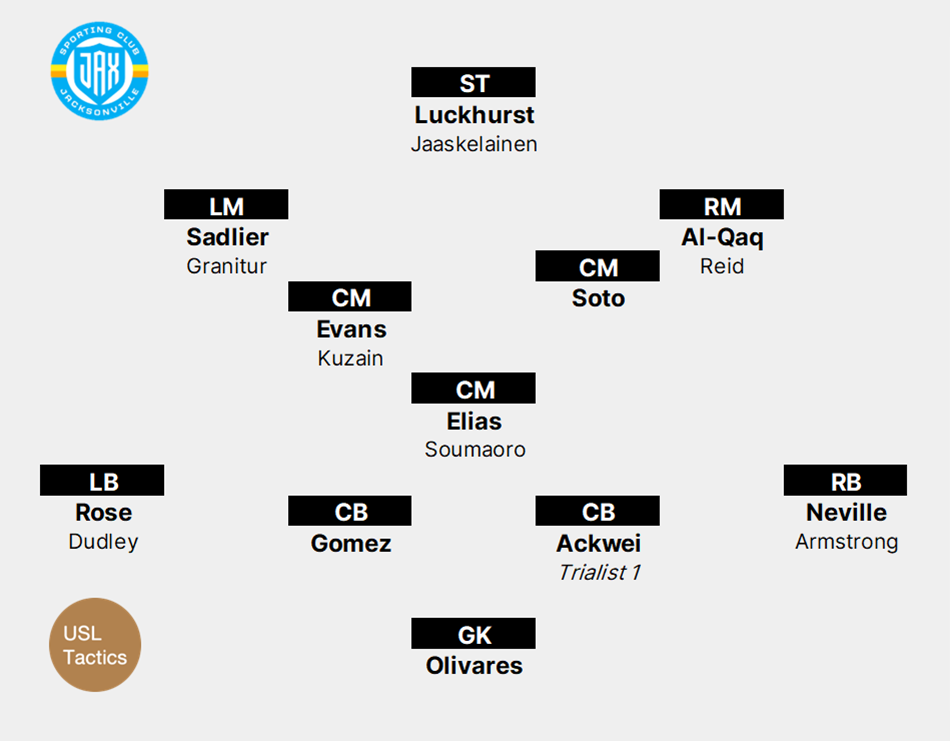
The starting unit went about 60 minutes, with the exception of Piero Elias at the No. 6 spot. The former NYCFC II standout felt a bit disengaged in Jacksonville's midfield-skipping system, and he came out at the half for Brem Soumaoro. Emil Jaaskelainen got the second-longest run-out off the bench and looked fine enough, though the game state dictated that he didn't get as much room to shine as Luckhurst did from the jump.
There’s a new, fairly mediocre Glen Powell star vehicle out call How to Make a Killing, in which Powell is in line for a multi-billion dollar inheritance – if he can only get rid of his other relatives. It suffers from the very 2026 problem of being an “action-comedy” without the ”comedy,” but it’s a great to opportunity to rediscover 1949’s Kind Hearts and Coronets. The plot of that movie the same, except it features Alec Guinness playing each of the family members in increasingly ridiculous costumes and makeup. Guinness tends to get reduced to Obi-Wan Kenobi in the cultural memory, but there’s rarely been an actor with such tremendous range.
Also: I’m very tired of snowstorms.