The Back Four: Free Agents, First Edition
Initial free agency thoughts, plus Super League tactical trends

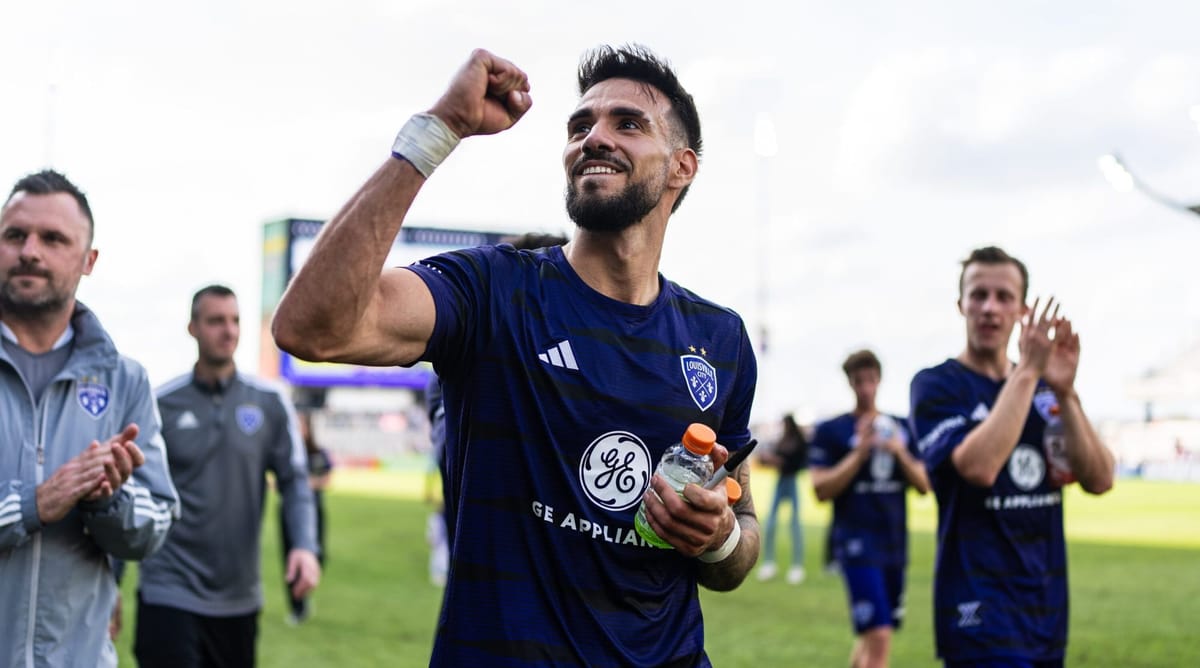
Welcome in to The Back Four!
As always, visit Backheeled for more USL content, including last week's offseason preview. Also, check out This League! for an audiovisual dive into the week that was.
Without further ado, let’s get to it.
Arturo Ordonez
In 2023, Arturo Ordonez was the USL Championship’s Defender of the Year. A year later, he was a first-team all-leaguer at the heart of an elite Louisville defense. Now, despite being benched halfway through 2025, Ordonez might be the best free agent on the market.
A superstar losing his starting job is a red flag. You can’t avoid that! The 28-year-old didn’t appear a single time after being pulled at halftime against Indy on August 30th this year, yet Ordonez’s track record is essentially undeniable. In his final season in Pittsburgh, Ordonez won 64% of his total duels, including 76% of aerial battles. In a more demanding Louisville system in 2024, those numbers held strong at 60% and 66%, respectively.
Yes, Ordonez’s efficiency numbers came down to earth in 2025, but he still brought varied utility to the table. We think of the defender as the centermost safety net in a back three these days, and he can be excellent in that role. It’s easy to forget that, on top of those contributions, we’ve seen a more complete profile from Ordonez over his four USL seasons.
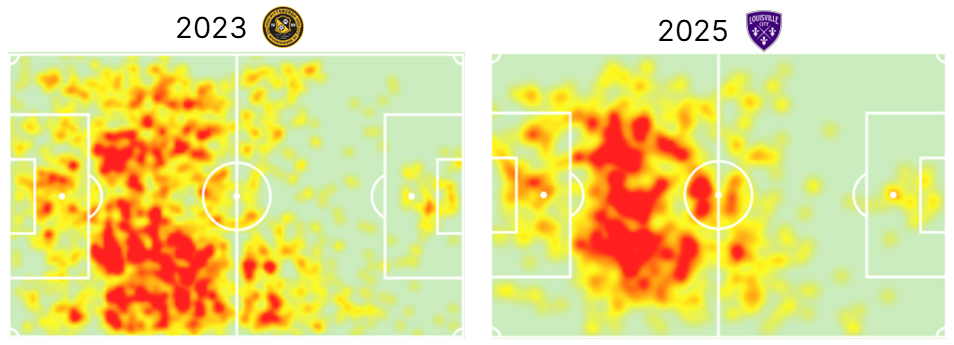
In his first two seasons coming out of Pitt, Ordonez played a healthy number of minutes on the right side of the Riverhounds’ back three. Pittsburgh wasn’t quite at “Rob Vincent title run” levels of field tilt during those two seasons, but Ordonez still made an offensive impact. The defender completed 1.44 final third passes per game while at Highmark Stadium, a number that dropped to 0.78 in Louisville.
All the while, Ordonez established himself as a premier USL set piece threat. He’s posted 8.9 set piece xG across his four pro years, including a 2023 campaign that represents one of the top-ten xG seasons in Championship history. In practical terms, the center back has added six goals and created five chances from dead balls across his career.
That’s a nice summation of Ordonez’s two-sided attacking impact, but he makes his money as a dominant defender first and foremost. In both Pittsburgh and Louisville, the now-28-year-old provided in-box solidity with a rangy knack for contributions closer to the halfway line. Ordonez is fourth in the USL in interceptions (188) and seventh in clearances (449) since making his league debut.
Here, you’re getting a prime example of an Ordonez-esque intervention – only this time, it doesn’t come off. This play, perhaps pertinently, occurred in the defender’s last game in purple.
At the start of the sequence, Indy is taking a throw-in from Louisville’s left side. When the ball comes Ordonez’s way, he can’t beat the opposing striker to the ball, and the committed nature of his attempted intervention creates problems. Louisville’s left-sided center back is already occupied upfield, meaning that there’s a gaping hole in behind as Ordonez steps high.
You see the result: Indy knocks the ball ahead, and there really ought to be a dangerous shot at the end of the clip.
For three years, Ordonez always made the right call in these situations, but that was less true in 2025. I’m absolutely not saying he was bad, but the standard at LouCity and Josh Jones’ surprising rise meant that a few key mistakes suddenly banished Ordonez to the bench.
Still, even the “poor” moments were counterattacked by classic Arturo Ordonez. Here, barely a minute after the defensive sequence shown above, you can see the defender making his mark with the ball.
Louisville is in the midst of a soft attacking reset here, with the Eleven bearing down against the backpass. Under pressure, Ordonez doesn’t blink. He shifts onto his right foot, bends a pass around a closing No. 9, beats the Indy midfield as well as center back James Musa, and sets up Phillip Goodrum in stride. Good luck finding any other center back who’s doing that with regularity.
Ultimately, whatever team ends up with Ordonez is getting an elite central defender. Even in a tough 2025 season, you still saw the features that made Arturo Ordonez the USL’s best defender. He didn’t lose his trademark traits, and the underlying talent is all still there. There’s no reason Ordonez won’t find that level again in the right system.
League One!
We’ve got roster updates from about half of USL League One thus far, and a number of star players have come free. It’s safe to assume that a number of those players will end up in the Championship…but I’m not here to predict that. Instead, I want to highlight some guys that I really like watching.
Start with Rodrigo Robles, who’s a free agent coming from the Greenville Triumph. Robles racked up seven goals and seven assists in 29 USL starts last season, mixing inverted left-wing minutes with some time on the right. Whether as a forward in a 3-4-3 or more traditional wide man in a 4-2-3-1, Robles was a consistent threat in South Carolina.
Here, Greenville is forcing a turnover on their right side, with a fullback intercepting the ball and immediately pushing upfield. You can see Robles start scanning space as soon as the ball comes the Triumph’s way, probing between two opposing defenders. Even as the break slows, Robles continues to side-step and keep his hips open; when a through ball angle comes around, the Spaniard is ready to chase it and find an angle in the box.
Robles takes the ultimate shot on his left foot, though all five of his League One goals this year came on his right. It’s that two-footedness that makes the 25-year-old all the more exciting. I don’t necessarily know if Robles will earn a Championship move, but he’s going to be a very strong pick-up if he remains in the third division.
While Antelope Valley technically hasn’t announced their roster moves, an accidental leak on Instagram revealed that all-league Eduardo Blancas and star right-sider Sebastian Cruz are both coming free. They’re terrific, but I want to ride for Walmer Martinez.
Frankly, it was a surprise that Martinez left the Championship level after a strong 2024 season in Monterey. It’s no surprise that he excelled with Alta, but doing so while covering left back, right back, and both wing positions made it all the more impressive. Brian Kleiban’s possessive 4-2-3-1 demanded position-to-position flexibility, and Martinez made it happen in multiple senses.
Martinez’s movement was consistently strong, and he posted 92nd percentile final-third passing numbers with Alta. He was also a 70th percentile dribbler on a roughly median success rate, using that tool to break defenses down in a system that discouraged turnover-creating crosses. For my money, Martinez would be even sharper in a more open system, and someone in the USL is likely to find that out in 2026.
Elsewhere, the reigning champs in Knoxville are losing multiple significant contributors from their title-winning roster. Kempes Tekiela probably headlines the attacking losses, having shifted from a 10-goal scorer of a No. 9 in his 2024 League One debut to an elite second striker in 2025. There’s little that Tekiela can’t do.
Still, it’s Sivert Haugli that’s the belle of the ball. Haugli previously had a spell in the Championship while mostly playing as a No. 6, but it’s his revival as one of League One’s best center backs that ought to renew interest in the second division.
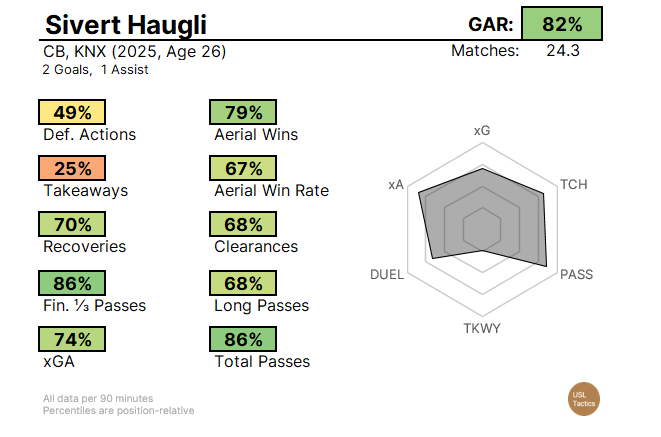
I highlighted Haugli’s passing during the postseason – he’s a terrific right-footed distributor from the left side of a center back duo – but that’s just one part of his totally complete profile. Haugli was rarely asked to step up like an intervenor in the One Knox system, but you’d struggle to find a better stay-at-home option in terms of clearances or dueling.
At 6’5”, the 26-year-old is nigh unmatched in the air. Not only is Haugli good at winning the initial header, but he’s precise about where the ball lands. Knoxville led the league with a +122 margin in recoveries this year, and Haugli played an important part in making that happen. You can imagine him as part of a back four or back three without much mental strain; if he stays in League One, Haugli is probably the favorite to win Defender of the Year.
Who else stands out? I sung Rafael Jauregui’s praises throughout 2025, given the sophisticated role he filled as a hybrid right wingback-winger in Charlotte. Jauregui always showed potential as a prospect in Sacramento, and the 20-year-old may be on track for a Championship return after a standout year as a League One starter.
Richmond is in a transitional winter, and they’ve also got a few key pieces to watch. Simon Fitch has ranked in the 70th percentile or better for his dribble success and at least the 55th for xA in three straight seasons, and you’d struggle to find a more consistent right back across League One. A Richmond native, it’s somewhat surprising to see Fitch leave the Kickers, but he figures to be a cornerstone piece wherever he lands.
Texoma’s drop to League Two also opens up a few key players. Ajmeer Spengler (nine goals, four assists) is the headliner, but players like Brandon McManus and Luke McCormick can clearly be attacking contributors. Further back, defensive midfielder Ozzie Ramos and fullback Reid Valentine – still only 20 years old! – ought to find a place in League One.
There’ll be plenty more names joining the mix soon enough. Tormenta and Spokane haven’t announced their options yet after stellar ends to the 2025 season. Westchester and maybe even Madison are due for rebuilds. There’s going to be a ton of talent on the market, and demand couldn’t be higher with five(ish) expansion teams joining the league.
Other Championship free agents
Up in the Championship itself, we’ve also seen about half the league announce player retentions and releases. There are a ton of big names available as free agents – just look at Charleston! – and I’m here to spotlight two more of my favorites in addition to the aforementioned Arturo Ordonez.
Start with Arthur Rogers, who missed the end of the 2025 season but was a major factor for a first-place Tulsa team all year long. The 29-year-old Rogers cut a different profile than the more physical options that prevailed in Luke Spencer’s back line, but it was his creative ingenuity that gave Tulsa a necessary breath of fresh air at the back.
When he was on the pitch, Rogers was responsible for 10.5% of Tulsa’s touches in the final and middle third. That’s astronomical for a center back, and it ranked him second at his position behind only Matt Mahoney. Meanwhile, Rogers outperformed his expected completion percentage by 3.5% amidst that high-usage deployment. You see why above, where the former USL League One Defender of the Year threads a stellar pass between the lines to set Tulsa up in the final third.
Whether you need a wide option in a back three, a table-setting fullback, or even a serviceable creator at the No. 6 spot, Rogers can do the job. The right-footer is great in his own box as well, having been dribbled past just eight times in 2025 while leading the league in clearances per 90. I can rationalize why Tulsa moved forward, but Rogers ought to be in high demand.
Up front, Russell Cicerone’s exit from Sacramento came as something of a shock. While Cicerone is entering his age 32 season and has suffered from mild-to-moderate availability issues on occasion, he still looked like a workhorse for Neill Collins. And…ya know…he notched 12 goal contributions!
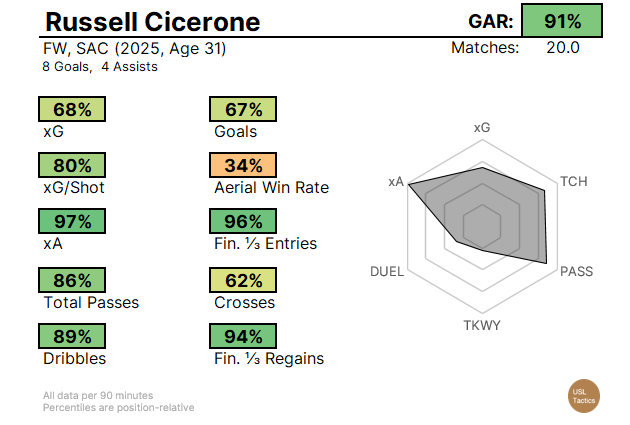
As is typically the case, it’s the do-it-all aspect that stands out for Cicerone. You probably don’t want him as your primary No. 9 if you’re a crossing team, but Cicerone’s ceaseless effort in the press, dogged create-his-own-shot dribbling, and heady ability to either shoot or pass close to goal is still elite at the USL level.
I generally dislike playing the matchmaker game. Many of the players that’ve been announced as free agents have already signed a contract somewhere, and analyzing actual signings is more rewarding than making dumb guesses. That said, I would love to see Cicerone join back up with Mark Briggs in Birmingham, particularly if he’s coming off the left with Ronaldo Damus at the No. 9 spot.
I want to shout out another ex-Republic player in goalkeeper Jared Mazzola, who showed enough to earn a starting spot somewhere in the USL – whether in the Championship or as an identity-setting star in League One. Mazzola was absolutely stellar in the Jagermeister Cup, leading all goalkeepers with 2.33 goals prevented. He didn’t just excel while sticking on his line, either; no goalie with three or more cup starts exceeded Mazzola’s 10.29 recoveries per match.
Who else stands out? For one, I’m still holding my Mo Traore stock. We know the 23-year-old center back’s limits as a passer, but the guy was a key piece for a title team in recent memory and is skillful enough to be a plus-level starter as he exits Phoenix. Elsewhere, Maliek Howell might’ve struggled to stay fit and nail down a spot for the Legion after arriving via trade, but the Jamaican international – a wonderful discovery for Dennis Sanchez’s Las Vegas Lights two seasons back – deserves a job somewhere. The center back still completed 50 passes per game and won 64% of his duels despite playing for two bad teams!
Seeing Manuel Arteaga leave Tampa Bay after an up-and-down season wasn’t shocking, but he’s still got something to offer in the right setting. It’s easy to forget that Arteaga didn’t miss a game and scored a very respectable nine goals (on perfectly solid 14.7% conversion!) despite seeing his box touches drop by nearly 30%. His ability to combine edge-of-the-box presence with high-end scoring should guarantee solid contributions in 2026.
Again, there’s plenty more to come in the Championship. Colorado Springs, San Antonio, and Rhode Island could be due for major re-tools after underwhelming campaigns. The reigning champs in Pittsburgh have yet to announce their retentions, and the ‘Hounds usually see a handful of big players earn interest across the USL. Add in a rich set of free agents in North Carolina, and it ought to be a winter full of meaningful movement.
Territorial control in the Super League
Way back in the spring, I highlighted how the USL Championship was pivoting toward a more direct style based around the idea of "field tilt," and we kept following up on that idea on This League! throughout 2025. While the year-over-year trends in that direction aren't as marked in the Super League, we've seen the same ideas influence the table in a major way.
Right off the bat, there's been a change in terms of passing trends. In the 2024-2025 campaign, Super League clubs attempted 443 passes per game, averaging 7.49 vertical yards per pass. This year, the passing average is down to 431, with distance up to 7.66 – and that's despite the fact that Jacksonville is on track to be the shortest-oriented team in the (short) history of the division. In other words, the pattern is even starker when you simply look at the eight carryover clubs.
As we sit amidst the league's holiday break, what's remarkable is how tightly connected the tilt metrics are with on-field success. Four teams have a 50% field tilt or better, meaning that they attempt more final-third passes than their opponents. Those four teams – Lexington, Jacksonville, Carolina, and Fort Lauderdale – currently occupy the Super League's four playoff positions.
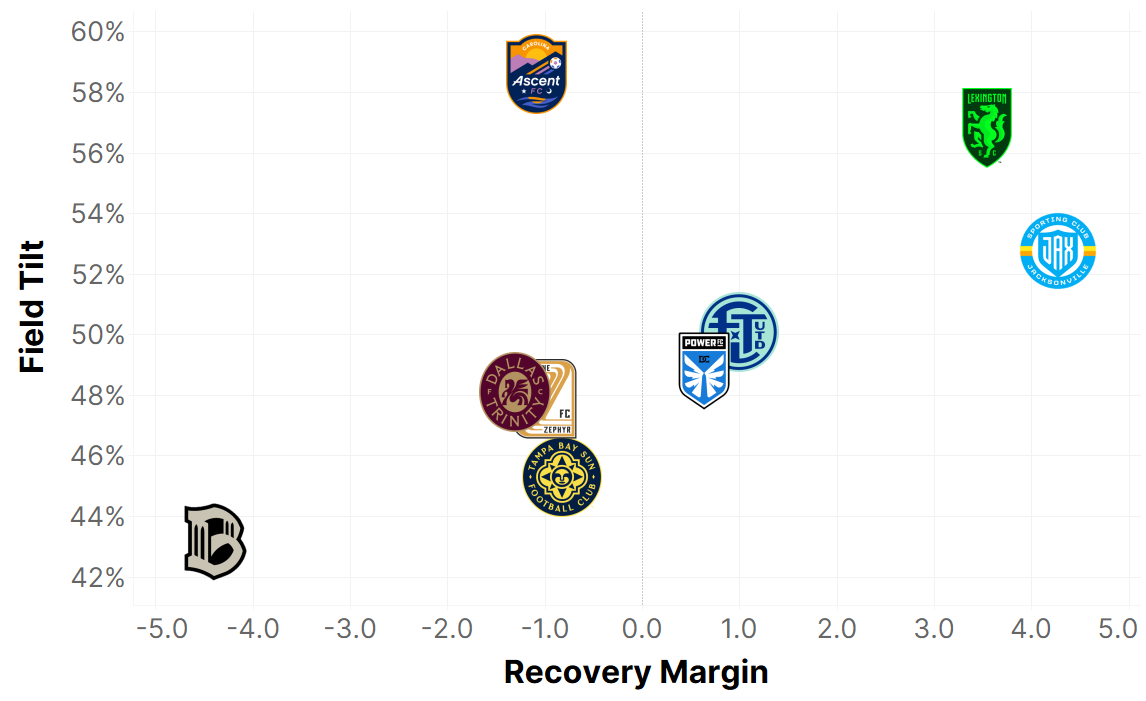
As always, there’s a chicken-or-the-egg question here. Are these four clubs good because of the field tilt, or is that a natural result of other things that are going well? For my money, it’s the former.
What’s undeniable is that the “big four” are all aggressive pressing teams. Carolina, Lexington, and Jacksonville are the only three clubs in the Super League to put in defensive actions 44 yards upfield (or higher) on average, while Fort Lauderdale, Lexington, and Jacksonville are the only sub-8.5 PPDA teams in the division. Those presses look different: Lexington and Carolina typically go 4-2-4 and relish high takeaways, while Fort Lauderdale can mix up their 4-2-3-1 to force errant downfield passes. Jacksonville starts in a 3-1-4-2, breaking up the formational homogeneity. Still, the end result is the same across the quartet.
Defensive identity stirs the stylistic drink far more than attacking principles. Jacksonville and Lexington are two of the league’s three leaders in long goal kicks; Carolina goes short nearly 90% of the time. Fort Lauderdale completes less than 300 passes per match and relies on stellar counterattacking, but the other three clubs are all top-four possession sides. The offensive tenets vary, but it’s high pressure that’s allowing for field-tilt dominance in each case.
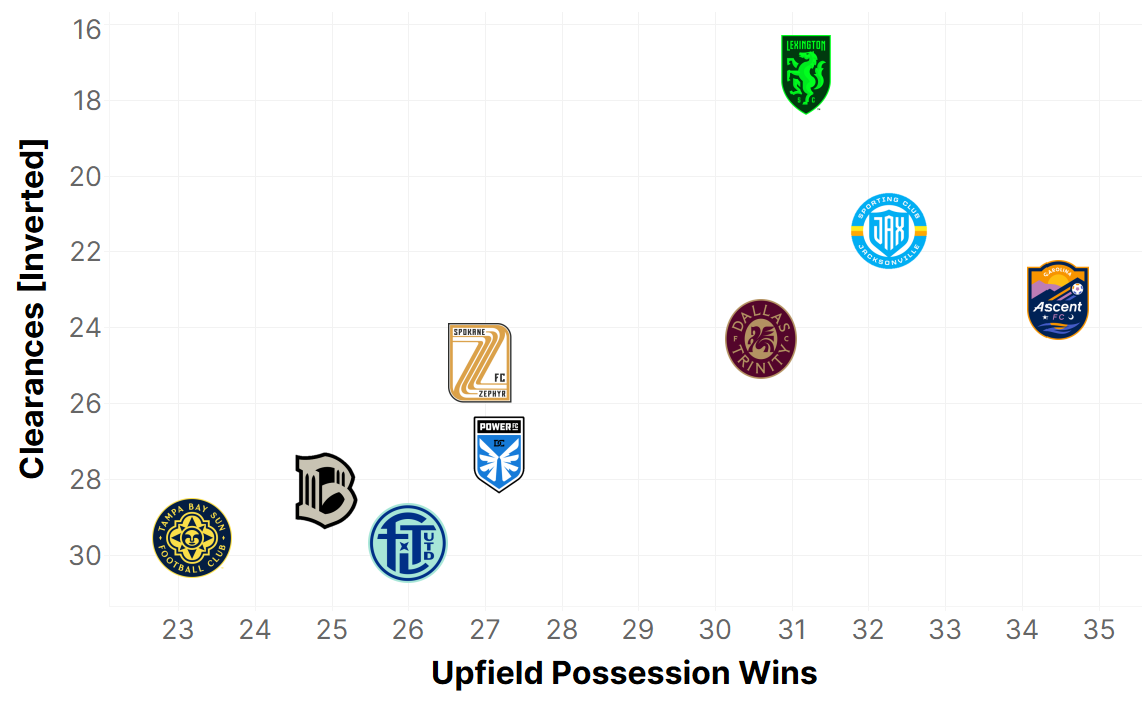
Comparing upfield possession wins (i.e., final- and middle-third recoveries) with clearances (usually made in one’s own box) provides another angle from which to view pitch control. Again, you’re seeing familiar faces – this time joined by Dallas, who’s three points back of a playoff spot with a game in hand for a reason!
When you’re forcing your defenders to make big plays close to your own goal, that’s a bad thing. Lexington prevents that from happening, allowing stars like Emina Ekic and Addie McCain to dominate through intricate passing sequences at the opposite end; at the same time, you'd trust defender Allison Pantuso implicitly. Carolina relies on fluidity centered around MacKenzie George and Rylee Baisden, but they've also got a stellar back line headlined by Sydney Studer. That completeness is a final commonality for the league’s best teams.
As we enter the final month of first-half play, the statistical trends will continue to weigh heavily. Soccer is far from a “solved” or optimized game in the way that, say, baseball has become, but smart teams are learning how to improve their odds within the modern tactical meta. Masaki Hemmi’s Lexington and Stacey Balaam’s Jacksonville – two teams under brand-new managers – have done so to the greatest degree, and it’s a major reason why they’re setting the bar in the 2025-2026 season.
Quick Hits
In other news this week…
- We’ll see what gives format-wise over the next few weeks. I'll probably do another free agency thing like this once the rest of the USL Championship and League One announce their stuff, and signings will come sooner rather than later. I'll also be doubling up on Super League segments through the Christmas holiday.
- Go check out Alex Ashton's round-up for the complete picture on League One's offseason to date.
- My friends at The Union Report had an awesome sit-down with new Monterey head man Oliver Wyss, who's one of the most respected figures in the USL for a reason.
- I unintentionally indulged a Christopher Plummer double – thanks, American Airlines' in-flight movie hub! – while traveling for Thanksgiving, so shout out to The Sound of Music and Spike Lee's Inside Man. I basically can't watch The Sound of Music without crying, and you'd be hard-pressed to find something more moving (and, dare I say, politically relevant) than the final "Edelweiss" performance. Meanwhile, Plummer gets to be an ex-Nazi in Inside Man, which features an overload of double dolly zooms and other Spike Lee tricks on top of a typically magnetic Denzel Washington performance.