The Back Four: Easy being green?
On Lexington's Championship splash and Super League dominance, plus more USL miscellany

Welcome in to The Back Four!
As always, visit Backheeled for more USL content, including a chat with Rob Vincent about Pittsburgh’s title-winning tactics. Also, check out This League! for an audiovisual dive into the week that was – offseason shows coming soon.
Without further ado, let’s get to it.
Lexington's spending spree
If you weren't online on Friday night, you missed the one-hour bonanza where news broke about Lexington signing Arturo Ordonez, Luis Felipe, and Aaron Molloy. In terms of star power at the USL level, you couldn't do much better.
Ordonez (who I covered last week) is arguably the league's best center back at his peak. Aaron Molloy is, by my reckoning, a top-ten Championship player and just made my all-league ballot. Luis Felipe was an anchor for Sacramento's years of deep US Open Cup runs and is somehow only 29 years old.
We'll get into the tactical fit for the trio, but these moves are a statement of intent above all – one that’s reflective of Lexington’s entire modus operandi. We’ve seen this club splash on intra-USL talent in the Super League and run laps around their competition. Now, Lexington is hoping to do the same in the Championship, and their long-horizon roster strategy is helping to make it happen. The club sent out nearly 10 players on loan last year, most of whom were in the shop window. That Lexington earned a sizable transfer fee for Ates Diouf (loaned to Detroit last year, purchased outright last week) is part of how they could trigger Molloy’s low-six-digits release clause.
In an offseason that will be defined by bifurcated squad-building philosophies, Lexington is firmly in the “big spender” camp. Numerous clubs are going the opposite way, relying on cheaper sources of talent like League One, MLS Next Pro, and college soccer. We’ll see how LSC fills out the roster, but they’ve already sealed three of the biggest additions of the 2025-2026 campaign.
What might it look like on the pitch? The USL can be a reactive league, and there’s a chance Lexington goes back three in the wake of that formation defining the postseason.
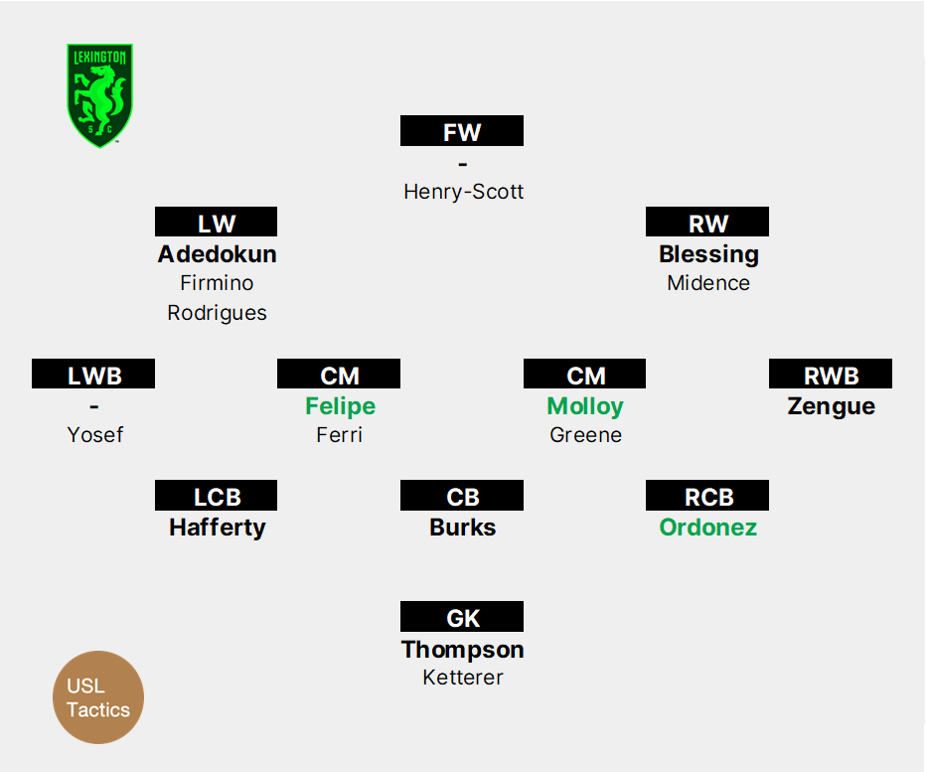
Now, could it be a classic 4-2-3-1 in which Molloy drops low in possession? Of course! That's the way Molloy has been maximized for the last five years between Memphis and Charleston, and it would avoid the semi-awkward re-positioning of Joe Hafferty over to the left (though he did start there in the 2025 Open Cup).
Still, it's easy to see a three-at-the-back system paying off. If you look at the example of the Pittsburgh Riverhounds’ playoff 3-1-5-1 and Louisville City’s Players’ Shield-winning variant on the same shape, the USL skewed strongly toward field-tilting back threes in 2025.
Under Terry Boss, Lexington even experimented with a “three-box-three” alignment. Their 52.2% field tilt ranked ninth in the league – just behind Louisville, Pittsburgh, and Tulsa. Now, LSC has the weapons to actually pay off that territorial dominance like their betters did in 2025.
When I think about a pivot pairing of Molloy and Luis Felipe, my mind drifts toward Louisville as a blueprint. For one, Felipe is the USL's best analogue for Kevon Lambert, specifically in how LouCity deployed him last season. Under Danny Cruz, Lambert was allowed to push up in that 3-1-5-1ish context whilst Taylor Davila sat lower as a recycler and occasional penetrator.
The result for the Jamaican international? 1.1 shots and 5.6 aerial wins per game, plus three total goals. Luis Felipe did similarly in Sacramento, putting up 1.5 shots and 4.9 aerial wins a match.
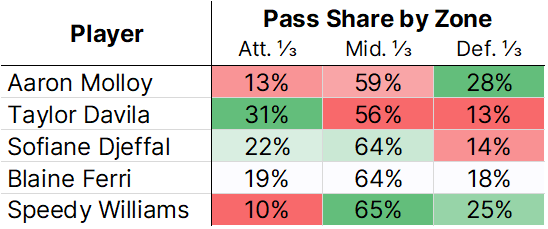
Putting "Aaron Molloy" and "needs to be used differently" together is silly. You can't argue that Molloy was misused in Charleston; the Battery put up the USL’s most xG by using him in deep-lying positions, forcing defenses to overextend before pinging into the attacking half. Still, it’s remarkable to see how much of his activity was centered in the defensive zone compared to Lexington’s No. 6s and No. 8s – much less Davila over in Louisville.
You can see that changing if LSC becomes more Cruz-esque, tilting the field with a high Felipe and using Molloy as a table-setter further upfield. Especially with Ordonez and Kendall Burks as marauding, destructive safety nets, it's easy to see Molloy playing with more freedom closer to goal.
Lexington’s transition into a more efficient territorial offense that maximizes Molloy will rely on the addition of a physical No. 9, of course. If Latif Blessing and Michael Adedokun start in the pockets, they’ll need to be committed two-way presences. I must repeat that a 3-4-3 isn’t guaranteed; it might be in the zeitgeist, but this roster is already talented enough to support a host of formations.
It’s far too early to label any team as a favorite, but expectations in Lexington will be sky high in 2026. When you do this much in the offseason, you’re inviting pressure. That’s a good problem to have, but it means that a club which has never made the postseason will be under intense scrutiny.
Signing potpourri
Who else made waves this week? Let's return to Louisville City, who replaced twice-loaned goalkeeper Damian Las with Loudoun United stalwart Hugo Fauroux. Since he took over as Loudoun's starter in 2023, the now-29-year-old Fauroux has been one of the USL's most improved players. I don't claim much expertise when it comes to goalkeeping, but the Frenchman has grown ever more poised as a shot-stopper and ball-mover by my eye test.
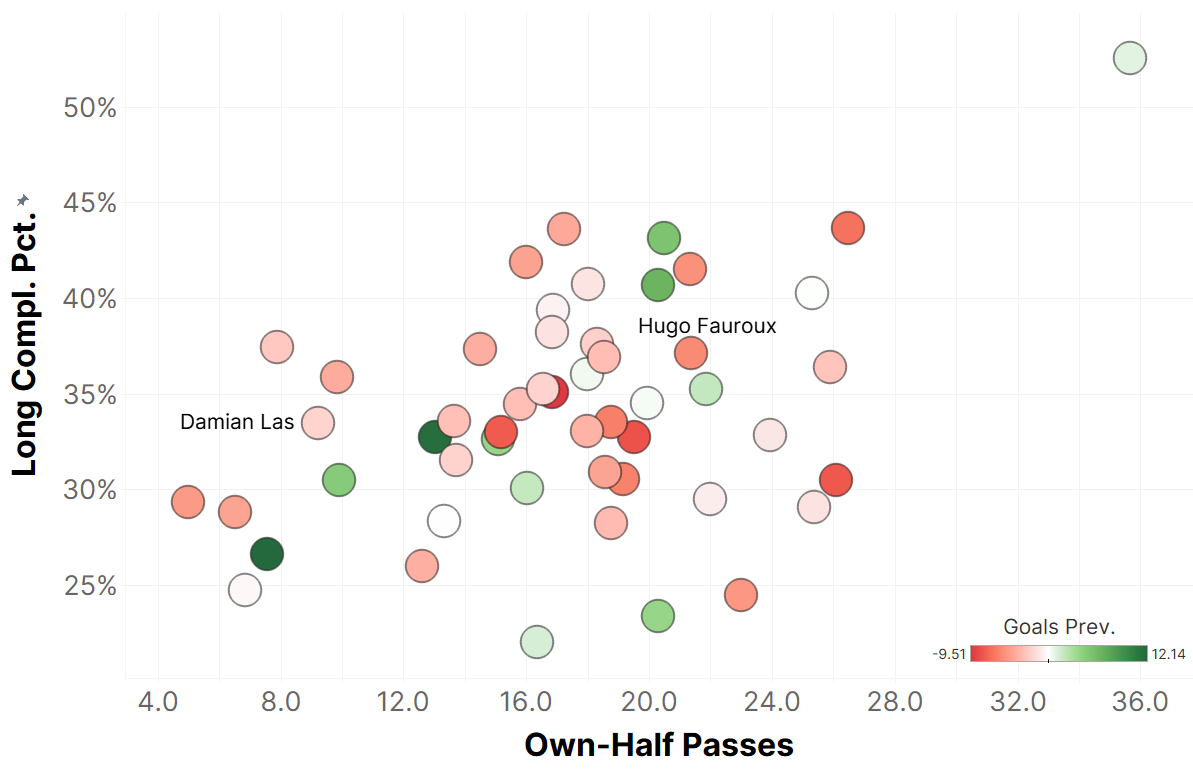
Now, the numbers don't necessarily back me up. Here, you're seeing all starting goalkeepers in the USL over the last two years mapped out by their own-half completions (by per-game count) and long completion percentage (by percent), shaded by goal prevention numbers. In other words, someone closer to the top right is a better passer, while the greener the shade of the circle represents better shot-stopping.
This chart is ruined by Rocco Rios Novo being insane up in that far right corner, but Fauroux still stands out for his plus-caliber passing. Meanwhile, you can see how little Las was asked to do in the run of play. Neither player actually projected well by the advanced goalkeeping numbers; Las allowed 2.0 goals above expected, while Fauroux was 5.7 underwater.
I like to rely on the numbers, but the expected data is unduly harsh toward Fauroux. Loudoun had a tendency to fold in transition situations – particularly in 2024 – in a manner that put Fauroux under extra duress. While it's true that the Frenchman is good for an occasional mistake while coming off his line, you generally trust him to do the job. Whether his confident passing under pressure changes Louisville's build game is the real question; I implicitly trust Fauroux to do the job in net.
The standout of early free agency (at least in terms of confirmed additions) has been Tampa Bay, who won't stop making major signings. Last week alone, they inked Russell Cicerone, Karsen Henderlong, and Pedro Dolabella; reports indicate that MD Myers is on his way to Al Lang Stadium as well.
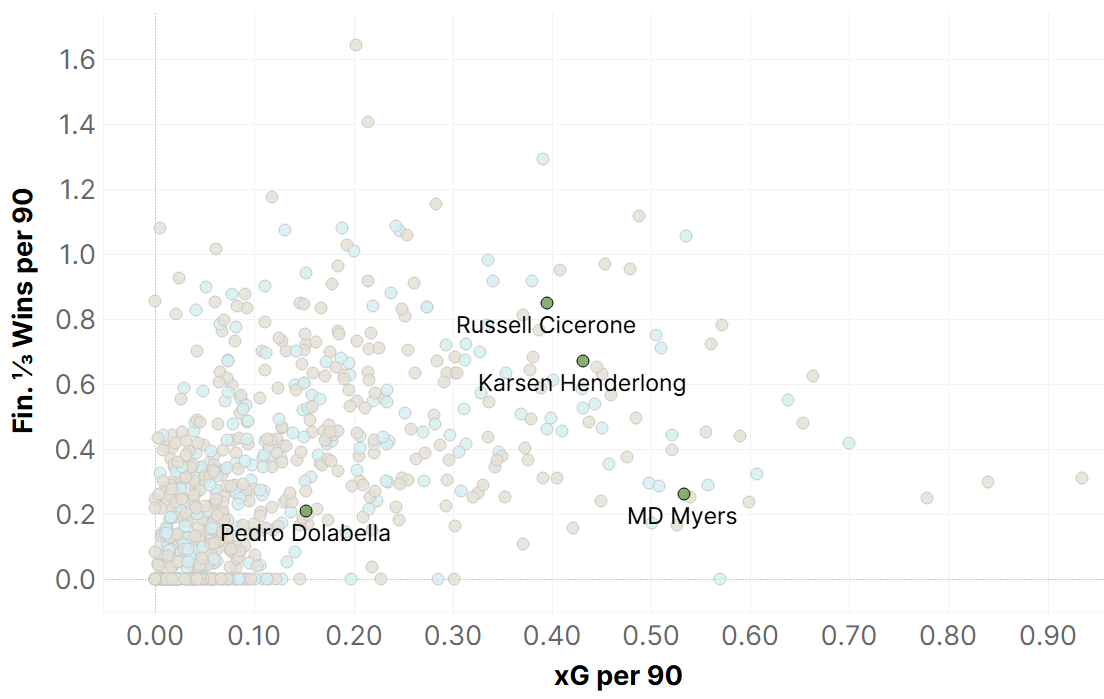
There’s a clear commonality between the attacking signings: these players, repositioned Dolabella notwithstanding, combine top-end scoring instincts with spirited participation in the press across 2025. That’s especially true of Cicerone and Henderlong, who combined for nearly 1.5 final-third recoveries per match between them last season.
What’s remarkable about the foursome is the sense of balance they represent. A front line of Cicerone, Myers, and Dolabella could see the ex-Charleston striker reprise his connective role at the No. 9 spot, allowing Cicerone to do his classic run-in-behind thing. Dolabella also showed ample ability as a deeper-seated, right halfspace No. 10 in North Carolina last year, which would take the burden off of Myers. Taken together, the three Championship imports combined for 8.1 xA last season.
Dolabella adds another dimension entirely, largely due to the versatility he flexed in League One that was less prevalent with NCFC. When Dolabella played under Dom Casciato for Union Omaha, it was common to see the 6’4” dynamo defend as a No. 8 in a defensive 5-2-3 before pushing high in an attacking 3-1-5-1; that combination let Dolabella pick up more than 5.0 recoveries and 2.6 shots per game in 2024. Moreover, such an arrangement would give Henderlong – who played wider during his brief stint in Indy – extra opportunities to star.
In a league as demanding as the USL, you need depth across your attacking group. Already, the Rowdies might’ve given themselves the best offensive core in the Championship, bar none. As Cicerone, Henderlong, Dolabella, and Myers gain chemistry, that effect is only going to become more marked.
Now, is the midfield behind them steely enough to stop the best attacks in the Championship? That remains to be seen. I adore Max Schneider (who contributed 1.5 interceptions and 6.7 duel wins per game last year), but a pairing between him and either Alex Mendez or the oft-injured Lewis Hilton would need to prove their collective. Casciato has continually found ways to balance his lineup over the years, and he'll need to do the same for Tampa Bay in 2026.
(Aside: The fact that Indy had Henderlong on the roster in 2024, used him as a left mid a couple times, and then let him walk is bananas.)
Brecc Evans, Henderlong’s teammate in Naples, was probably the biggest mover of the week within League One. Next year, he’ll almost certainly slot in as the starting left-sided center back for Portland Hearts of Pine.
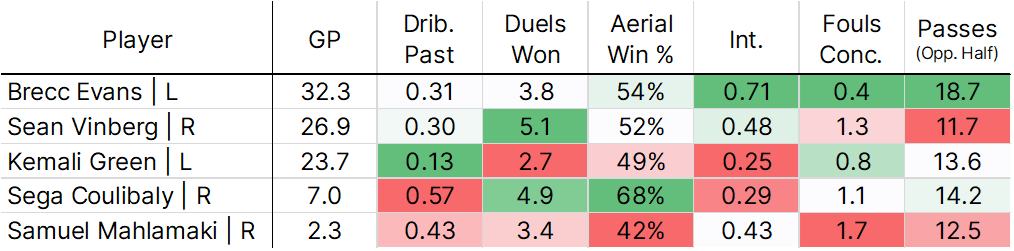
Evans was an integral part of Northern Colorado’s Jagermeister Cup run in 2024, and he helped to anchor Naples’ stellar expansion campaign last season. Even though Naples finished with the second-lowest possession share in the league (44.5%) and didn’t prefer short build, Evans still managed to take 60 touches per game and generate far more attacking-half activity than any of Portland’s defenders.
Moreover, the 26-year-old brought a level of balanced aggression that ought to fit like a glove within Bobby Murphy’s system. Evans made more interceptions than any Hearts center back, yet he conceded less fouls than almost any of his positional peers in League One. Meanwhile, he was stronger in the air and more active in duels than Kemali Green, Portland’s most-used left-sider. It’s rare to see a player blend defensive aggression, intelligent timing, and on-ball quality quite like Evans, and that means his addition will be a coup at Fitzpatrick Stadium.
I suspect there’s more to come from Portland, but the left side of that team is already locked in as the best in the division. Ollie Wright (a USL Show all-leaguer!) is returning on the wing, Nathan Messer is back at left back, and they’ll both be boosted by Evans’ ability to set the table from the defensive line.
Lexington, still unbeaten
If you're looking for a sequence that explains Lexington's stellar start to the Super League season, you'd be hard-pressed to do better than this:
You’re seeing Lexington build out in what’s essentially a 3-2-2-3 shape, or a “three-box-three.” To make it happen, right back Alyssa Bourgeois pushes up the sideline to provide a winger’s presence in the attacking third; meanwhile, right winger Sarah Griffith and second striker Addie McCain stay narrow to create paired No. 10s ahead of the pivot.
By using McCain and Griffith as central presences, Lexington overwhelm what's typically a pressureful 4-2-3-1 from Tampa Bay. The Sun narrow out, defender Alison Pantuso (shifted into a wider role within LSC's possession shape) spots a lane upfield, and striker Catherin Barry can hold play up in the final third.
Whether Lexington is engaging Barry directly, hitting switches to Bourgeois or McKenzie Weinert at the sidelines, or passing their way through McCain as a central hub, they're impossibly hard to stop. That's been the formula all season long, but we saw it limited this Saturday with Spokane coming to town.
In some ways, that's a trend. Before Thanksgiving, Tampa Bay used a hard-nosed 4-1-4-1 with a relatively high back line to compress space. They earned a draw for their efforts. In every phase, Zephyr gave Lexington a legitimate challenge by repeating the trick. Nicole Lukic's side essentially pressed in a 4-1-4-1 with hard pressure on Taylor Aylmer (via Felicia Knox) and Tati Fung (from Emma Jaskaniec) to limit build scenarios.
LSC isn't afraid of long goal kicks or hoofed passes from central defense, but they prefer variety. Instead, Spokane's marking scheme put a lid on progression through the lines, especially in a rampant opening 20 minutes. Tight marking from fullback Kelsey Oyler also limited Emina Ekic – in for Griffith as the right-sided No. 10 – as a controlled receiver between lines.
That's not to say Lexington failed to find chances in the attacking zone, but it put an extra onus on LSC to recover the ball upfield. Though Masaki Hemmi's side won 60% of ground duels, they ended up with a 48% minority of recoveries. Still, though, counterpressing structure like you're seeing below exemplified the system's durability.
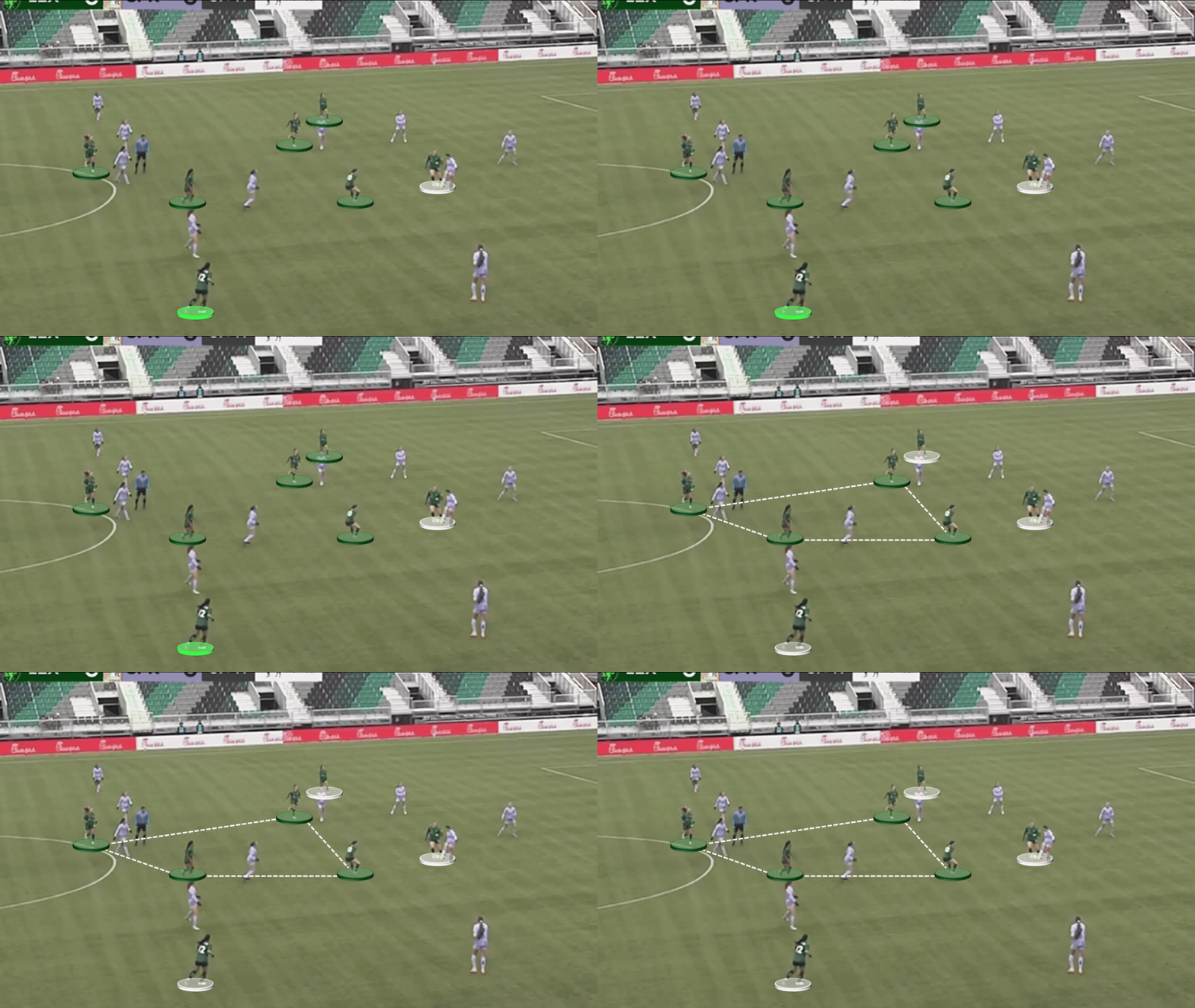
Across the clip, you can see how the 4-2-3-1, midfield quintet in dark green, maps onto that aforementioned "three-box-three." Bourgeois is the hinge at right back, ready to either track deep in case of a long ball or push forward like an attacker in case of a recovery (hence why she's marked in white in the second frame). The midfield is mostly in 4-2-3-1 mode, but you can still see the remnants of the boxy overload. Offensive patterns are feeding defensive structure, and vice versa.
Scenarios like these weren't always easy to execute upon, particularly when Jaskaniec – who took a team-high 69 touches – could operate as a deep hold-up outlet over the front wave of the counterpress. Likewise, Cam Tucker and Leah Silano knew when to drift wide, hence why they attempted 10 dribbles between them. Spokane brought a pace of play to the table that challenged Lexington's phase-to-phase transitions in a way few teams have been able to across 2025.
Still, when LSC earned their game-tying penalty, it came from a similar setup to that you're seeing above – go long, rely on your structure to force a recovery, and then quickly play upfield. Good teams can earn results the hard way, and Lexington is proving that ability.
You might look at Saturday's late equalizer and a 0.9 to 1.6 xG deficit as a sign of weakness, but it's really the opposite. Spokane needed to press with the highest intensity we've seen all year (see 11 final-third recoveries!) and benefited from a bye week to prep. If you need an extended run-up, fresh legs, and a flawless defensive gameplan to even draw Lexington, that's a very good sign for Hemmi and co.
(Also: Hannah. Sharts. Long. Throws.)
Ain't no sunshine
The Tampa Bay Sun are in a weird spot. The club rode a seven-match unbeaten streak into the weekend (good!) but were routed 3-0 by Jacksonville (bad!) on Saturday. Eight or so starters every week were a part of Tampa Bay's 2024-2025 title team (good!) yet the 2025-2026 edition of the Sun are in dead last (bad!), nine points back of the cut line.
The underlying numbers aren't any better. Tampa Bay's -0.46 per-game xG margin is shaping up to be the second-worst in the Super League's short history. What was once a fearsome press is recovering possession in the final and middle thirds merely 23.8 times a match, on track to be the lowest in the division. Denise Schilte-Brown hasn't blinked in the face of the poor start, but the tics that make Tampa Bay Tampa Bay are looking more and more like shortcomings.
How do the Sun try and play? If you saw this team last year, you know the basic story. Tampa Bay lines up in a 4-2-3-1 or 4-1-4-1 and is relatively direct. They're a rather narrow attacking team, allowing attacking mids like Carlee Giammona and Sydyny Nasello to cut inside as hyper-active dribblers. Thus, the Sun need their fullbacks to pull double duty, providing offensive width while also getting back into block after turnovers.
During their debut campaign, Tampa Bay eventually settled on a pivot pairing of Jordyn Listro and Jade Moore that held things together through the middle. Listro, a former Canadian international, is as excellent as ever as a box-to-box No. 8. Moore – who put in 0.8 final-third recoveries, 2.7 takeaways, and 33 passes per match – retired at the end of last season.
Sandrine Gaillard, the recent partner for Listro up the middle, has been meh-to-fine, good for 63rd percentile duel attempts and recoveries amidst minimal passing success. Likewise, adding McKenzie Pluck at right back and shifting Victoria Haugen to left back has been about the same: fine. In a system where those positions are paramount, however, the extended settling-in period has exposed chinks within the Sun's armor.
Here, I’m breaking down an exemplary play into two parts, starting with a giveaway in possession. Tampa Bay begins here with a “2-3“ base of two low center backs behind a fullback-No. 6-fullback line, hoping to draw Jacksonville’s attention upfield. When the Sun try and break lines, it happens by way of a pass into winger Sabrina McNeill’s feet through the high press.
For the most part, McNeill played as a fullback for Fort Lauderdale last season, including in the title game against Tampa Bay. On Saturday, she started on the left wing with Giammona as a No. 10, but you can see how narrow she gets in this instance. As she moves in, McNeill is marked by an opposing wingback and has no choice but to first-time a pass into Haugen at the sideline.
It’s a bit of a high-wire act to get to this point, Tampa Bay isn’t in a bad position on paper. They've drawn the press, broken lines, and found an open outlet. The rub? No one replaces McNeill up the left side. Haugen has a brief window in which she could advance play, but she’s forced to pass backwards because the requisite off-ball movement isn’t there. Tampa Bay is forced right back into the wringer, and they give the ball away.
That’s par for the course in the 2025-2026 campaign. Tampa Bay is down from an already-low 320 pass completions per game to roughly 260. Their average possession lasts just 2.6 passes, the worst in the league and 19% lower than in their inaugural season. In this specific clip, you see the defensive knock-on effect of that sloppy possession game…
…as Jacksonville are quickly able to break past the narrow midfield and high fullbacks to create an overload in the channel. The transition shape isn’t bad, and the center back pairing of Brooke Hendrix and Vivianne Bessette has been as terrific as ever in 2025-2026, but this absolutely isn’t a situation you want to be in.
When Jacksonville found their first shot of the match in the 31st minute, it relied on a long ball that forced Haugen to cover narrow; Listro and Gaillard had been played over, and trouble ensued. When the guests went up 1-0, it was the result of an extended possession sequence that began with a giveaway in build. Across phases, Tampa Bay simply hasn't been sturdy enough through the middle.
You can point to the small-but-impactful personnel changes and to the simple fact that the Super League’s level improved, but Tampa Bay is also making mistakes in their own right. We saw this club rebound from a relatively slow start to win it all last season, but the task feels far bigger as we barrel toward 2026.
Quick Hits
In other news this week…
- Sneaky great business from Las Vegas in adding Ben Ofeimu and Jared Mazzola this week. I’ve long adored Ofeimu’s ability to carry the ball forward from the right side of a defense; he leads the USL in “wow, I can’t believe that defender is so high upfield” moments, and I mean that as a high compliment. Meanwhile, Mazzola – who I highlighted briefly last week – has more than earned a starting job in the Championship. They combine to give Devin Rensing a great base for the Lights’ re-tool.
- On the other side of the Lexington business this week, I love Speedy Williams’ return to Colorado Springs. I’m not pretending that Williams (who turns 34 in April) will combine with post-injury Zach Zandi to make the Switchbacks a contender again, but they won’t hurt.
- Richmond already has a lot of attacking depth on the sly, but I’m very into Tarik Pannholzer.
- I continue to bear the standard for this year’s Stephen Soderbergh duopoly, and I only feel better about that after rewatching Black Bag. Michael Fassbender, Cate Blanchett, and a killer supporting cast (including Pierce Brosnan!) made a wonderfully tense spy thriller and nobody cared? It’s got a great score and unique cinematography – the light is soft and hazy in a way that’s deeply distracting if atmospheric – on top of the tight plot. Good movie.