The Back Four: Shark Week
On Corpus Christi, plus Indy's upside and Super League notes

Welcome in to The Back Four!
As always, visit Backheeled for more USL content, including last week's rundown of 2026 breakout players and an upcoming feature on youth development. Also, check out This League! as we continue to preview the 2026 season.
Without further ado, let’s get to it.
Considering Corpus Christi
The tough thing about a preseason power ranking is that you're working with one hand tied behind your back. A week or so ago, I slotted Corpus Christi in as the 18th team out of 18 in my inaugural Backheeled USL League One Power Rankings. Now, with a handful of new signings entering the fray, I'm more than willing to change my tune.
In the first place, it’s safe to assume that the Sharks will be a stout defensive unit, and that owes to manager Eamon Zayed’s track record. Over Zayed's three seasons with Northern Colorado, his Hailstorm conceded merely 1.1 xG per match, tied for third-lowest of any League One club. Zayed proved successful at identifying talented players to anchor his team, but he was even more successful at instilling a sense of structure and discipline. Per Opta, the Hailstorm committed just four errors leading to goals across 87 USL matches, another bottom-three mark.
Northern Colorado was far from a high-budget operation – when they paid their salaries at all. Corpus Christi is cash poor by League One standards, but they’ve used their resources to build an accomplished defensive core already. Jack Keaney and Sam Roscoe have played more than 3,000 minutes in the ongoing first-division season in Northern Ireland and should start in central defense; goalkeeper James Talbot has more than 140 career appearances for Bohemians, one of Ireland’s premier clubs.
Assuming Zayed goes back to his 4-2-3-1 or 4-3-3 roots, the heart of the back line is settled. In front of that core, familiar faces like Jackson Dietrich, Patrick Langlois, and Enock Kwakwa – all Northern Colorado stalwarts – will bring instant understanding through the pivot.
The reason I’ve grown especially interested in Corpus Christi involves two signings made late this week: midfielder Tomas Pondeca and winger Kaihim Thomas.
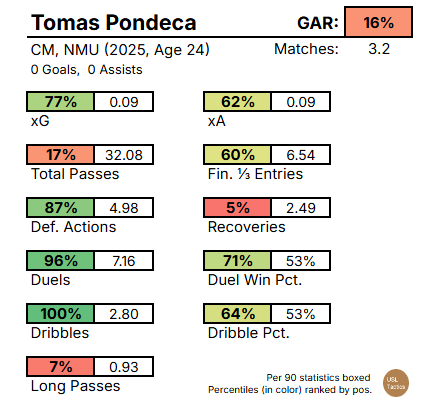
Pondeca spent 2025 on loan with New Mexico United after two stellar seasons with MLS Next Pro’s North Texas SC, and he flashed terrific potential even if he couldn't claim a rotation spot. Still only 25, Pondeca is a powerful ball carrier and intervenor through the midfield.
I wouldn’t classify Pondeca as a No. 10 in a traditional sense, but he’d be the progressive powerhouse in a trio alongside Dietrich and Langlois. New Mexico kept the midfielder somewhat deeper, but in North Texas, he was good for 2.6 shots and 2.2 box touches per 90. In the best-case scenario, there’s the makings of an all-league player under Zayed’s stead.
Thomas, meanwhile, has an immediate point of comparison in ex-Hailstorm winger Real Gill. Both are Trinidad & Tobago internationals; the latter played for Zayed in 2024, and the former will do so in 2026. Now with One Knox, Gill posted 0.58 goal contributions and 2.1 dribbles per 90 in his season with Northern Colorado.
While Thomas is a different style of attacker, there’s a clear precedent for a vertically-oriented player of his ilk flourishing in the Sharks' system. Thomas provides a lithe presence and stands 5’8”. To my eye, he lacks the burning pace that Gill brought to the table. Still, there’s off-kilter craft and killer instinct to his game that ought to play splendidly in Texas.
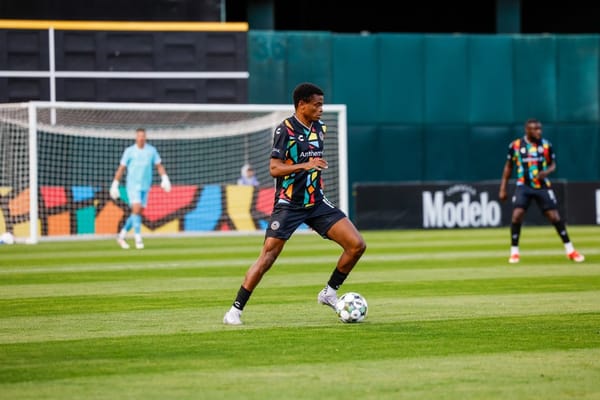
You get a few tastes of that skillset here. Thomas can be seen making well-timed cuts into the box from the weak side, creating separation on the dribble, and picking spots to leak out on the break. The 23-year-old is primarily right-footed, but he’s capable of left-footing a final ball under duress.
Will Thomas be a 10-goal guy? Probably not, but he’s crafty enough to work alongside striker Alexis Cerritos, who’s a wonderfully clever mover in his own right. Corpus Christi will be difficult to mark at the barest minimum, though I would like to see this team get a heftier No. 9 in the door. Still, you can see a world where the Sharks can spread the final third like Zayed’s best Northern Colorado sides. End product is the question, but the principles are in place.
I felt bad about my ranking for Corpus Christi at the start of the month, but League One isn't making it easy for me. Frankly, it’s hard to look at any team in this division and conclude that they’ll be out of the playoff hunt. That’s a testament to the way that League One has grown, and it’s a credit to soccer minds like Zayed that are incredibly talented at making the most of the resources in front of them.
Indy Eleven: the optimist's case
I'm jaded, and I own that. Longtime readers will know that I’m an Indianapolis native who got interested in this dumb sport because of the Indy Eleven. They’ve mostly repaid me by being mediocre at soccer.
That might not change in 2026, but there’s reason to hold out hope. In 2025, Indy was old. With an average age of 27.7, they were one of the five oldest teams in the Championship. My current depth chart projections still peg the Eleven at an average of 27.3, but that’s informed by caution. In a perfect world, Sean McAuley will be able to blend familiar veterans (Aodhan Quinn, Jack Blake, Eric Dick) with prime-age additions that’ve arrived from the lower leagues.
With that goal in mind, let’s imagine a best-case scenario:
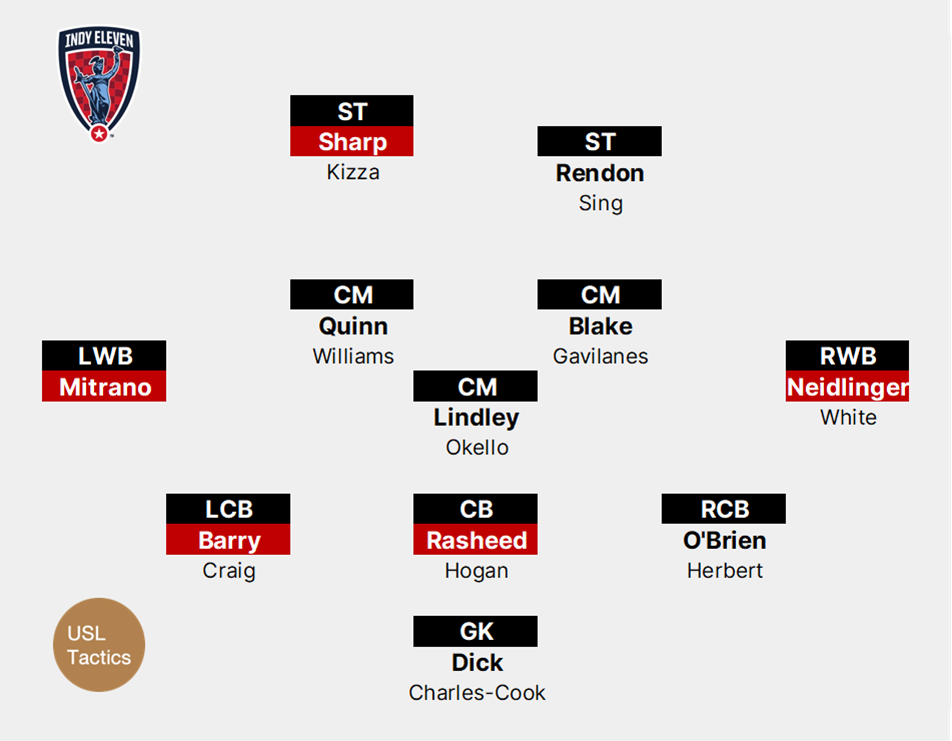
Do I think that this'll be McAuley's lineup come March 7th? Probably not. Does it maximize younger additions in a reasonable manner? I think so!
Logan Neidlinger is the cheat here as a returning player, but he's someone that I expected to see more of in 2025 in the first place. 2024 saw the then-teenager put up 5.5 defensive actions per 90 and pitch in two goal contributions at right wingback in about 900 minutes. As it stands, Neidlinger is likely behind Bruno Rendon (relocating from forward) and possibly Hayden White (more defensive-minded) in the 2026 depth chart, but he’s a nice middle ground – one that could give Indy needed two-way consistency.
The left side is somewhat less clear. Again, I'll hedge by saying that Quinn is likely to start as that flank's wingback. If not, Alejandro Mitrano and Hesron Barry are both left back-center back ’tweeners that could fill the position. For me, Mitrano is the pick. He’s won a majority of his duels over the last three years; in Miami in 2025, he put up more than three crosses and 0.11 xA per 90 despite holding down a very deep-seated fullback role in that system.
By starting Mitrano outside, you can push Quinn inside and let him run the show through the lines. It’s all complementary: you spread the field from side to side with Mitrano and Neidlinger, then you benefit by maximizing elite creators in newfound space up the middle.
In terms of actually getting the ball to the final third – presumably in a 3-1-4-2 shape – Charlie Sharp is the right pick at striker. The 24-year-old had a middling loan spell with Tampa Bay last fall, but he’s a 90th percentile aerial dueler across his MLS Next Pro career and is surprisingly nimble for someone with those hold-up chops.
You see that above, where Sharp has drifted right to receive. The striker beats a defender, cuts inside, and then instantly shifts into “poacher” mode to find a rebound. Sharp isn’t the kind of No. 9 whose size is misleading; he knows how to be a presence. That’s obvious in the second clip, where he’s front and center as a crossing option in the box. Again, Sharp is there for the rebound goal.
The ex-Toronto II star will make the Eleven sharper on the break and add to their in-box gravity in more settled attacking sequences. If he’s as good as advertised, it’ll put the onus on Indy’s defensive corps to keep up their end of the bargain behind a successful attack.
At a baseline level, McAuley needs athletic defenders to support his system. Last year, Indy was willing to absorb pressure at times (they tied Tulsa for the USL lead with 30 clearances per game) but also wanted to be aggressive; the Eleven finished sixth in tackles, encouraging active intervention upfield from their center backs. If that’s the intention again in 2026, Barry and Makel Rasheed should be in line for major roles.
Barry played more than 2,000 minutes with New England Revolution II last season, holding down the left side of a back three and a small smattering of wingback run-out. In that deployment, the 26-year-old showed good lateral speed, won 62% of his ground duels, and made a very strong 1.6 interceptions per 90. The alternative choice on the left side of the back three is Paco Craig, who was once an all-USL stalwart but will be 34 by the time the playoffs roll around. If getting younger is the goal, there’s a clear choice.
Rasheed justifies a starting position on sheer talent alone. A former Nashville SC draft pick out of the University of Indianapolis, Rasheed exploded onto the scene for South Georgia Tormenta in 2025. A 6’5” powerhouse, the 24-year-old won 70% of his ground duels, 62% of his aerial battles, and added more than six clearances per game for good measure. Incredibly skillful at leveraging his size in tight spaces, Rasheed has the kind of first step that could anchor the Eleven’s defense.
Put it all together, and you’ve got a team that can tilt the pitch with a high line, move upfield with verticality, and support those patterns with defense-stretching width. McAuley won’t follow my half-baked suggestions, but I genuinely think that’s the direction Indy is trying to move. Whether it pays off is the major question for 2026.
Super League Whiparound
There’s a bit of brute force to the way Spokane Zephyr play. Under Nicole Lukic, this team wants to initiate long in build, quickly move upfield after regaining in the run of play, and maximize the field-tilting abilities of their 4-1-4-1 shape. It’s a system that’s full of unique tics, but it hasn’t led to consistent scoring for Zephyr.
Entering the weekend in the wake of Wednesday’s 3-0 loss to Jacksonville, this club ranked last in the Super League with just 0.94 goals per game. Admittedly, that’s a poor measure of Spokane’s attacking prowess; they’d underperformed their xG by a full 5.0 goals, the most in the division.
In that sense, Saturday represented a bit of deserved good luck. Spokane put just two shots on target, generated 0.47 xG, yet came away 2-0 winners against the Carolina Ascent. Lukic made a few lineup changes to help the cause, but the outcome felt like a reward for Zephyr’s overall system more than anything else.
Ironically, the Jacksonville game featured far prettier chance-creating sequences. In that match, Catherine Rapp started at striker with Lena Silano to her right; Ginger Fontenot, capable as a winger or defender, was the right back. Per Opta, 43% of Spokane’s final-third entries came up the right side, but there was a catch to that strength along the sideline. Too often, Rapp drifted wide to engage with her teammates, thus leaving Spokane without a proper No. 9.
As the match went on, those relationships changed. Silano was allowed to bleed inside, changing places with Rapp and essentially eschewing the idea of full-field width. The directness began to pay off; Emma Jaskaniec, who often defended deeper as a pivot player, could step higher like a No. 8 or No. 10 behind the forward line.
You see that dynamic above. Off a throw, Jacksonville’s back three is out of sync and undermanned. Zephyr identify that weakness, driving toward the center of the pitch and allowing Jaskaniec (in gold) to step. The midfielder’s run creates a three-on-two against the remaining center backs in tandem with Rapp and Silano (white), and a shot ensues.
This is a neat encapsulation of Zephyr’s final-third offense, but it also underlines the occasional lack of a box presence. Between the need to chase initiating long balls and contribute in the press, Rapp and Silano weren’t always there to occupy the 18-yard box at midweek. The solution on Saturday? Make Silano a proper No. 9, and get Fontenot onto the wing.
Spokane might not’ve lit up the box score, but their spatial relationships felt better against Carolina. Getting Sophia Braun into the midfield helped, as she and Jaskaniec combined for 13 recoveries. That second-ball control let Spokane skirt the Ascent’s trademark high press, accessing the upper reaches of their 4-1-4-1 with greater ease. Jaskaniec was key; beyond the recoveries, she contested 12 aerial duels and took six box touches as a functional second striker.
Did Zephyr score off a mishit cross from Fontenot? Sure, but that was a result of her placement. Was their second goal a shaggy breakaway for Silano? Yes again, but that was the vertical breakout strategy in action. Spokane made their luck. Zephyr have a clear identity, and they’re finally getting the finishing that this system should’ve beget all along.
Down in Fort Lauderdale, United played their first game under interim manager Paul Jennison after the dismissal of Ali Rogers. This team got played off the pitch a week back against Dallas Trinity, falling 4-0 without ever putting up much of a fight. Fort Lauderdale left the channels of their 4-2-3-1ish shape almost entirely unprotected, and their pivot was obliterated in transition.
Doing something to right the ship was a must. Fort Lauderdale was in the midst of a seven-game winless run entering the weekend, a stretch featuring a -5.3 xG margin and -12 goal difference. The improvements against Brooklyn FC were marginal, but they're a step in the right direction.
To get it out of the way, we'll start with the bad; namely, continued coverage issues through the middle.
You see the example here, where Fort Lauderdale’s centermost midfielders – Kelli Van Treeck and Abi Hugh from the pivot, plus No. 10 Jasmine Hamid – are all played past. That’s bad enough, but all three players overcommit to the same spaces and ball-watch thereafter. The inattention allows Brooklyn to score off an overcooked cross, moments after the original reception between the lines.
Now, this was one bad moment in a generally strong game from the pivot. Van Treeck’s versatility continues to be her strong suit, and her work rate as a No. 8 was stellar. Hamid balanced her responsibilities well, taking half-a-dozen box touches, putting up 0.5 xG, and scoring a late equalizer while still tracking back.
Was Hamid up to the physical challenge as a long receiver? Not necessarily, particularly against the gauntlet of Brooklyn’s 5-3-2ish defense, featuring Jennifer Cudjoe at the No. 6 spot. Still, Hamid looked energized in her new role, and that’s a credit to Hennison. I don’t know if Van Treeck and Hugh playing behind Hamid is the long-term answer, but it’s as good a bandage as any for now.
Across the state, Tampa Bay couldn’t quite get off the schneid in a 1-1 draw against DC Power. Jordan Fusco continued to impress on loan from San Diego with her second goal in three starts; conversely, the Sun conceded their ninth set piece goal of the year, the worst mark in the Super League.
I’ve harped on Tampa Bay’s up-and-down performances in the run of play, but that dead-ball deficiency is even more problematic. This team is -6 off set pieces this year, and while some of that is down to chance (their expected margin is merely -0.7) there’s clearly a focus issue at play.
Nevertheless, I want to put the spotlight on Alexis Theoret for DC. The former University of Virginia standout has become Power’s most important piece in her rookie season, ranking in the 80th percentile or better for final-third entries, total passes, defensive actions, and duel win percentage. She does everything for this team – and that includes committed recoveries in transition.
If you want to put a lid on Tampa Bay, you need to stop them on the break. For the most part, that means limiting players like Fusco and Sydny Nasello as they tear toward the opposing box out of the Sun’s low block.
That’s what’s happening here, but you can see DC finding their structure in real time. The three center backs (white) are in position, and Theoret (blue) goes all-out to limit the central lane. The Sun have no recourse, so Power are able to turn the ball over and quickly reverse the direction of play.
While DC allowed 1.7 xG in this match, Theoret and partner Emily Colton did well to put a lid on the danger. Throughout the 2025-2026 campaign, those two have been terrific no matter what they’ve been asked to do within DC’s “three-box-three.” If Power make a run into a postseason spot – they’re one win back of fourth place with a game in hand! – it’ll be the midfield group, anchored by Theoret, that makes it happen.
In other news…
The Griffin Garnett sale to Ferencvaros is a big deal™ for Richmond and League One writ large. We’ve seen a handful of third-division players get big moves, but Garnett is a proper academy product without any existing ties to bigger clubs or foreign suitors. He came up through the Kickers’ system, earned a starting spot, and became a USYNT-level prospect – all within the League One ecosystem. We’ve seen a handful of similar stories coming out of the Championship, but it’ll be enormous for the health of the USL model if Richmond is at the vanguard of a broader League One developmental glow-up.
In similar territory, I’m intrigued by Luis Alvarez’s loan from Tampa Bay to Charlotte. The star midfielder was signed via transfer from the Independence last spring, but he struggled to nail down a clear role within Dom Casciato’s system – despite the fact that, in my estimation, Alvarez has the tools to be an explosive Championship midfielder. There’s no doubt that he’ll be an all-USL candidate back in North Carolina; he picked up six goal contributions on 0.39 xG+xA and nearly 14 final-third completions per 90 during his last full season with Charlotte. Still, Alvarez’s case is fascinating relative to the Rowdies’ commitment to incoming League One talent this winter. Casciato has built a roster rife with experienced vets, but he needs a handful of his Alvarez-esque imports to come good for Tampa Bay to meet expectations.
A top-of-the-table tilt between Lexington and Dallas got delayed this Saturday in the Super League, but I really like the Darya Rajaee pick-up for LSC in the meantime. While Rajaee hasn’t been able to elevate Fort Lauderdale this year – who has? – she was a perfect Lexington-esque presence in 2024. She ranked in the 89th percentile for final-third entries and ground duel win percentage alike, combining progressivity with strong one-on-one skills going both ways. I don’t know who she displaces in Kosuke Kimura’s lineup, but Rajaee’s got the goods.
(Also: people with elementary counting skills may notice that I’ve got three sections in a “Back Four” newsletter. Yes! There are two reasons for that: (1) I’m tired and (2) I’m about 39,000 words into my 2026 season previews for Backheeled. If you subscribe here and aren’t paying $5 a month for the good stuff on Backheeled, rectify that.)