The Back Four: Winter whiparound
On Canadian imports, Lexington, Sophie Jones, and more

Welcome in to The Back Four!
As always, visit Backheeled for more USL content, including my inaugural League One power rankings. I’ll be deep-diving the league every single week this season on top of my existing Championship coverage.
Also, check out This League! as we continue to preview the 2026 season.
Without further ado, let’s get to it.
Oh, Canada
There’s been a slow, steady trickle of talent from the Canadian Premier League into the USL over the years, though the pathway to success hasn't always been direct. Movers like wingback Pacifique Niyongabire and center back Garven Metusala have proven to be useful role players; other signings like Ollie Bassett haven't been able to meet the hype.
Even so, the Championship has doubled down on northerly additions this winter. Shaan Hundal has an inside track to No. 9 minutes in Brooklyn, and Adonijah Reid is similarly positioned in Jacksonville. Kelsey Egwu looks like a nailed-on defensive starter for Monterey.
Last week, four more players – midfielder Sean Young (Loudoun), center back Callum Montgomery (Detroit), goalkeeper Jassem Koleilat (Birmingham), and left back Themi Antonoglou (Las Vegas) – joined the fray. All four will decide the competitive state of the Eastern and Western Conferences starting in March.
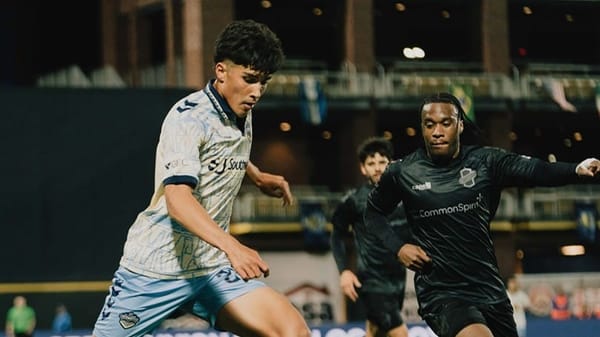
Young was Pacific FC's all-time appearances leader, and he feels like the belle of the cross-border ball. Loudoun decided to pay a transfer fee for the 24-year-old and inked him to a multi-year deal for a reason.
With more than 60 starts in the last three years, Young solidified his status as a box-to-box midfielder with game-influencing quality across phases. Last year, he won a majority of his aerial duels (54%) and ground duels (52%) alike. Fairly two-footed as a passer, Young is progressive without being wasteful; only 7.6% of his pass attempts were aimed “long” in 2025, and he posted an overall 85% completion rate.
You see Young’s instincts shining through here. Across these three examples, he’s seen dropping in for touches, harrying opponents to regain possession in useful areas, and connecting with both feet. In each case, Young doesn’t rest on his laurels after releasing his pass – he’s making an immediate run to draw defensive attention, open space, and potential receive.
I suspect (and hope?) that Young will be a starter for Loudoun whether they’re in 4-2-3-1 or 3-4-3 mode, and his skillset makes sense next to Bolu Akinyode’s destructive No. 6 profile or the retentive No. 6/No. 8 talents provided by James Murphy. Combined, they’re a formidable group that gives Anthony Limbrick real stability through the middle.
Elsewhere, Montgomery has starting-level upside for Le Rouge, and he’s bringing prior USL experience to the table. The 28-year-old spent a season apiece with North Texas, San Antonio, and San Diego before truly breaking out up north. Now, that resume is coming to Keyworth – and it provides real tactical clarity for this unit.
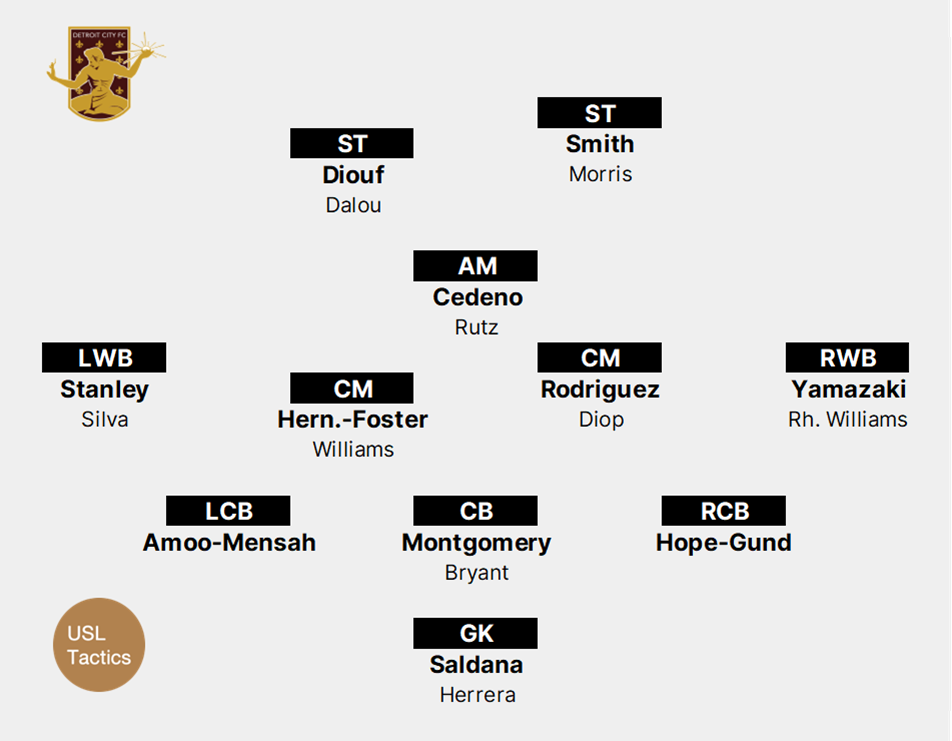
The center back usually started on the left side of Cavalry’s back line, baselining a team that ranked second in the CPL with a 53% possession share in 2025. Montgomery is 6’2” and dominant in the air, having won 80% of his aerial duels over the last two years. He’s grown as a progressor since his USL days as well; he completed 11 passes into the opposing half per 90 on a 70% completion rate last season.
In 2025, Detroit tended to defend in a 5-4-1 but shifted their left side higher upfield in possession. Montgomery makes that construction even more natural. He’s got the aerial dominance to control the game from the heart of a central defensive trio, and that left-sided passing makes him an able complement to the freer Devon Amoo-Mensah in that phase-based 4-4-2.
Koleilat, the CPL’s reigning Golden Glove winner, should be the undisputed No. 1 for Jay Heaps. The Forge FC defense he played behind was stout, but consider his numbers (per 90, of course) relative to the Legion’s goalkeepers from 2025:
- Koleilat: 0.83 goals against, 16.2 passes, 0.45 box claims
- Van Oekel: 1.61 goals against, 16.2 passes, 0.72 box claims
- Delgado: 1.73 goals against, 17.5 passes, 0.45 box claims
- Spangenberg: 1.83 goals against, 22.0 passes, 0.0 box claims
Last year, Koleilat was asked to be a fairly direct, low-volume passer with a moderate tendency to try and claim the ball off of crosses – exactly in line with the Legion’s platoon. The only difference? The Czech international filled that goalkeeping archetype while posting utterly elite shot-stopping numbers. In that sense, Koleilat ought to represent a meaningful upgrade in Alabama.
Antonoglou has the cloudiest pathway to minutes, though his upside is undeniable. A natural left back, the 24-year-old joins Jahlane Forbes and Blake Pope as viable starters in that spot for Las Vegas. His upside might be the highest of the bunch; Antonoglou notched 13 assists and created more than 60 chances over two seasons with Valour FC.
If you need a player that can effectively set up big strikers in Johnny Rodriguez and Manuel Arteaga, Antonoglou – who completed a very strong 30% of his crosses in Canada – is the man for the job. Again, that’s not a guarantee, but he’s got the kind of profile that makes sense.
Taken at a macro level, it’s no surprise that USL teams are looking to Canada. The CPL is considered to be roughly equivalent to the USL’s leagues, and its geographic scope readies imports for heavy travel. Signings from Canada are often English speakers that bring familiarity with a United States-adjacent culture. Throw those factors on top Young, Montgomery, Koleilat, and Antonoglou’s obvious talent, and you’ve got a recipe for success.
Gauging Greenville
The Greenville Triumph are a club in transition. Club founder Joe Erwin stepped down as chairman last fall, and vice chairman Doug Erwin followed in his footsteps in January. After seven years on the staff – including two as the Triumph‘s head coach and technical director – Rick Wright exited at the end of the 2025 season. The changes go beyond the personnel; a brand-new 6,300-seat stadium is coming in 2026.
Greenville is making moves off the pitch, scaling up to match the ambitions of League One’s flashiest clubs. On the pitch in 2026, however, there may be a deceptive amount of continuity.
By default, new manager (and longtime Charlotte assistant) Dave Dixon will innovate on the Wright formula. Likewise, the addition of former New Mexico United luminary Zach Prince to the front office represents modernization of the sporting hierarchy. Still, Greenville’s 63% minutes retention rate is the third-highest in the division, and change will only go so far.
In some sense, the Triumph don’t need a complete re-think. They famously reached the Jagermeister Cup semifinal last season, downing multiple USL Championship foes throughout the competition. In League One play, Greenville finished seventh (i.e., in the playoff tier) with a +4.8 expected goal difference. You could argue that a handful of debilitating injuries were all that separated this club from yet another postseason berth.
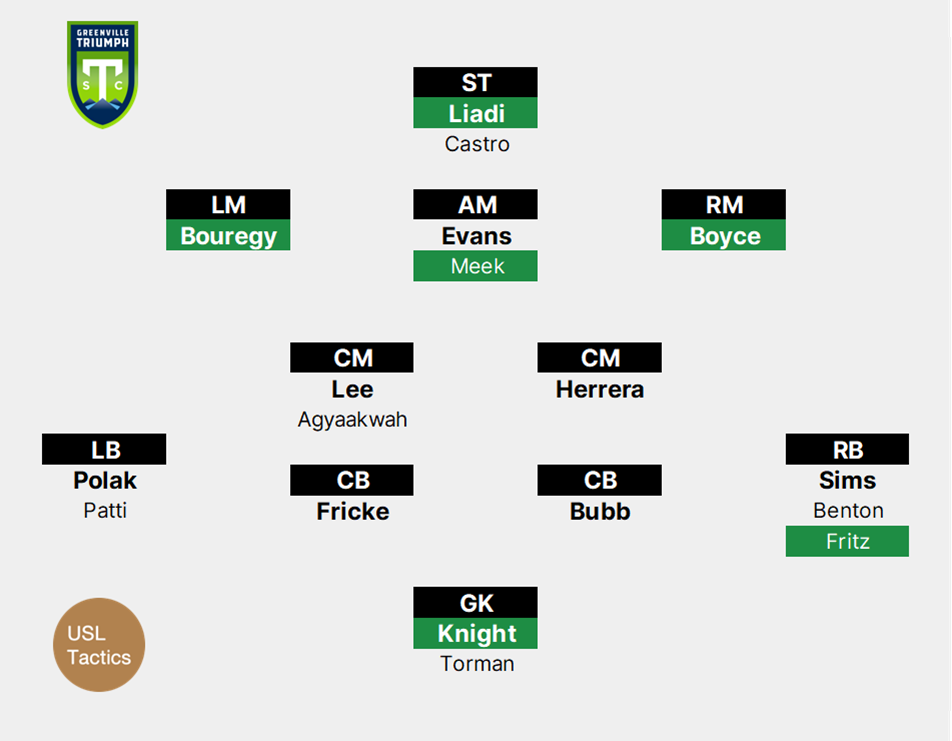
Dixon and Prince seemingly intend to lean on that old core in the new year, though they’ve added a few fascinating supplementary pieces to the mix. Some, like goalkeeper Amal Knight and winger Devin Boyce, are known quantities at this level; the latter even played for Greenville in 2023. Others, like attacking midfielders Jason Bouregy and Lucas Meek, will need to step up in (presumably) increased minute loads.
The Triumph’s biggest overhaul has come up front, where forwards and wingers like Ropapa Mensah, Ben Zakowski, Chevone Marsh, Pascal Corvino, and Rodrigo Robles are out. That group struggled to finish in 2025, but their pressing intensity was undeniable. Greenville finished third in final-third regains (3.6) and led League One in interceptions (9.7) per 90 minutes.
Dixon, party to far less aggressive Charlotte systems for the last few years, seems likely to change that calculus.
For one, Greenville may re-think their shape. Four fullbacks are returning, ex-UNC Greensboro standout Kimito Fritz has signed, and Championship veteran Patrick Seagrist just joined them last week. Given the logjam, would it be so surprising to see 33-year-old Tyler Polak serve as an elbow left-sider in a 3-5-2? Probably not. Likewise, Toby Sims – probably the best right back in the mix – is 6’1” unit that’s filled central defensive minutes at points in his career.
No matter the shape, the new attacking additions feel like strong fits. The return of visionary creator Connor Evans helps that cause. Evans started last season as a right back but eventually broke out as a progressive No. 8 and No. 10. He ended 2025 with 0.23 xA per 90 and a 91st percentile ground duel win rate – a mix of incision and efficiency that few in League One have ever matched.
Evans is terrific at finding touches and driving play between the lines, and Greenville’s pick-ups should complement that skillset ahead of him. Here, you’re seeing Bouregy in the spotlight, showcasing that sensibility.
While the 24-year-old rarely got time in Pittsburgh, he was a standout at Villanova and showed real flashes in the USL minutes he did earn. Primarily right-footed (but able to hit a final ball or shot on his left), Bouregy is a plus dribbler that can create separation at a high level. If a defense swarms to Evans, Bouregy is the type that can leverage the extra space created amidst defensive rotation.
At striker, Azaad Liadi will likely be in competition with Leo Castro – about to turn 37 years old – for starting time. Liadi struggled to stay fit on loan with Portland last year, but he put up 0.51 xG and won 9.9 duels per 90 in roughly 1,000 minutes. He’s imposing and knows how to occupy central defenders with real panache.
While you can argue that the Triumph’s roster is a house of cards on the basis of age (I did so in my inaugural League One power rank for Backheeled!), the competitive vision is starting to come together. Dixon and Prince have done well in the market, but now their challenge is to build on the successes of 2025 while also leading this organization into a new era. “Change” is the byword in South Carolina these days, but 2026 can’t be a success unless the Triumph’s new brain trust utilizes the great work that preceded them.
Green is good
In case you forgot, Lexington SC still hasn’t lost in the Super League this season. They’ve trailed for less than 200 minutes all year long, including a grand total of seven minutes in Kosuke Kimura’s still-nascent reign.
Saturday's mid-day battle pitted Lexington against a Carolina Ascent side that, in many ways, is their tactical clone. Both sides want to press in a 4-4-2 to tilt the pitch, and both are marked by the fluidity between their wingers and forwards. The similarities ceased in terms of execution this weekend; Kimura's unit was sharper, cleverer, and victorious as a result.

Carolina never made it easy. Last weekend, they kept just 45% of the ball against Jacksonville but achieved a 61% field tilt. Against LSC, they tried to do the same by pressing in a high 4-4-2, matching center backs Hannah Sharts and Allison Pantuso one-to-one. As Lexington built, variation emerged in that matchup scheme. Ascent forward Mackenzie George (purple) tended to drop a line against the progression of the ball, marking bounce-pass touches for Taylor Aylmer in the opposing pivot.
Above, she’s aided in that effort by midfielder Lily Nabet (orange) from the heart of the 4-4-2. George closes on Aylmer’s backside to prevent a turn and a switch of the point; meanwhile, Nabet denies midfielder Shea Moyer as a progressive option. In the first frame, LSC will have to play back to their goalkeeper. In the second, the ball is forced wide, but the pseudo-4-1-4-1 structure allows winger Shea Groom to mark the receiver.
That was the formula for Carolina: deny progression through the middle, leave one striker high to addle the center backs after backpasses, and try not to commit your wingers too high upfield.
Lexington found recourse in a few ways. Dropping Catherine Barry in from striker as a hold-up option was especially useful given her 6’0” size. Barry did well to maintain possession in the face of an elevated Carolina back line, marked by defender Jenna Butler’s especially aggressive posture. As such, lay-offs weren’t a cinch amidst the hyper-compact 4-4-2.
If LSC could manipulate the Ascent press with quick horizontal movement and then hit Barry, better options were on the table. The proof of that concept came 80 seconds into the game.
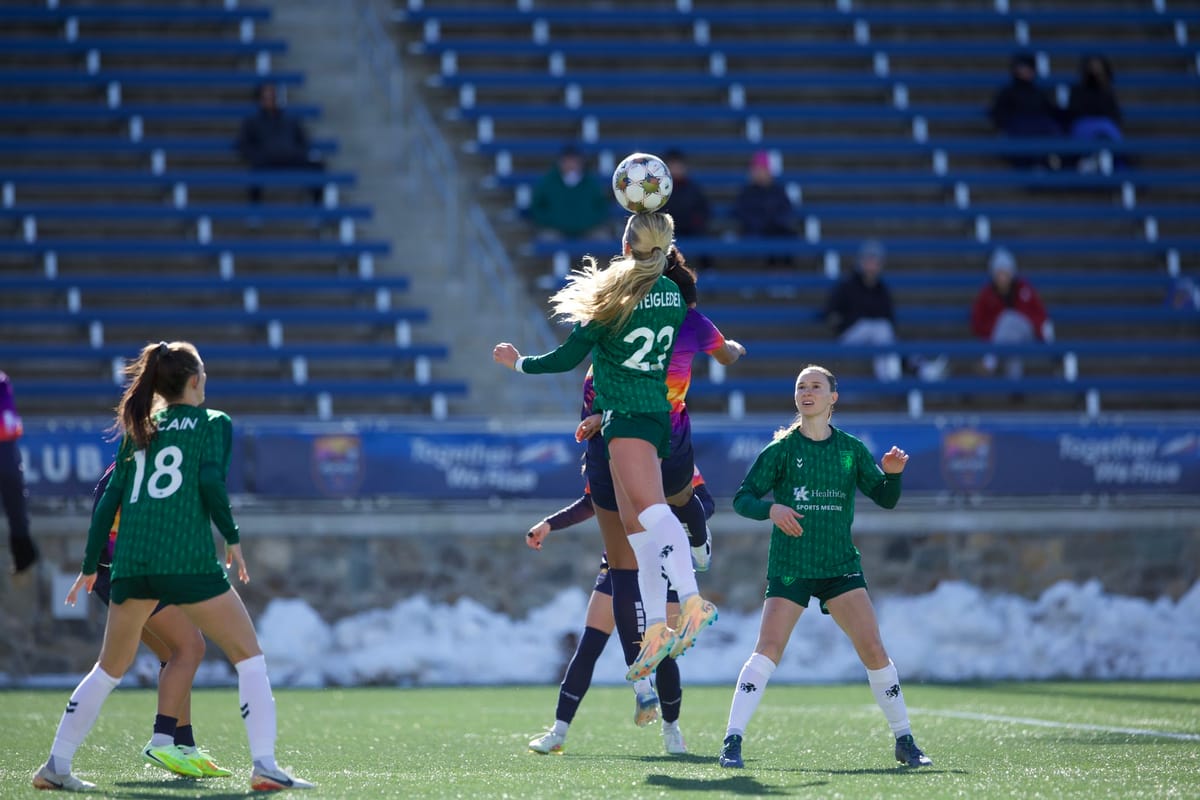
As Aylmer receives here, you’ll note that Lexington is essentially in a back three, dropping numbers down their left side. Left back Regan Steigleder is low and narrow, left winger Emina Ekic sinks to a wingback‘s level, and forward Addie McCain essentially positions herself as a center mid.
The result? Both of Carolina’s forwards need to stay high, and their right winger pushes against Steigleder while hedging against McCain. The spatial scheme is broken.
That’s where the dominos start to fall. Steigleder finds Ekic on the drop; Ekic beats the scrambling Carolina right back on the dribble. The entire Ascent defense is forced into rotation, Barry holds up, and she nails a through ball in behind to a streaking McKenzie Weinert.
Such manipulation wasn’t all that common, admittedly. More often, early service from the fullbacks around the edge was Lexington’s only option, given their formational rigidity in the face of the Carolina system. A few fullback-to-Barry sequences with the wingers making third-man runs were vaguely successful, and Alyssa Bourgeois tried a handful of ambitious throughs toward Weinert. Bourgeois herself put LSC on the board when a long-range cross was mishandled in the 43rd minute, but that fluky effort encapsulated the stop-start nature of her side’s attack.
"Exactly the sort of clinical counter move you need to break this defense down," equally applicable to Lexington's go-ahead goal.
— John Morrissey (@usltactics.com) 2026-02-07T20:21:06.196Z
Neither side was especially cohesive in a game that featured merely 2.3 total xG. The Ascent briefly led by counterpressing their way through Lexington’s less dogmatically compact 4-4-2, but the away side was equally able to do damage in transition – thereby undercutting Carolina's ability to bog the game down.
You see that above, where Kimura's wingers are above the level of the forwards; it's almost a dumbbell-shaped 4-2-2-2 by the time Aylmer recovers the ball at halfway. Aylmer quickly moves the ball upfield, where Barry and McCain’s deep positions are a siren song that draws Carolina out. Once again, there's a chance for Barry to thread Weinert through the lines of a rotated defense. The end result here is a well-deserved goal.
Could LSC have been slightly more innovative throughout the 90 minutes? Sure, but that's not their modus operandi. “It’s what we’ve been talking about since the day we came back – mentality,” said Kimura, in post-game comments to Crane Kicks Lex. “When we go up against teams built to compete and built to run, we have to respect how they play.”
Kimura evidenced that respect for Carolina, but he still found ways to vary his attack. He also told CKL that "we like to ask Cat Barry to come over to the side and overload and switch the point of attack, and it’s a double-edged sword to defend against," which shone through on Saturday.
This Lexington side has sharpened up since December, and it's a massive credit to Kimura's ability to balance the needs of a given matchup with his broader tactical, systemic goals. Now, that balance has LSC back up to first place.
On Sophie Jones
Defensive midfielders come in all shapes and sizes. Some are pure destroyers that sit central and break up opposing moves. Others circulate the ball in possession, setting the tempo and drawing attention amidst the press. Jacksonville’s Sophie Jones doesn’t fit cleanly into either bucket, but she’s immensely important to their winning formula.
Entering the weekend, Jones boasted an 80th percentile duel win rate (58%) and top-quarter recovery (5.8 per 90) and passing (44.2 per 90) numbers to go along with it. She’s a stern presence in one-on-ones, and she’s capable of setting the table on both sides of the ball. Jacksonville’s system, which vacillates between a high-pressing 3-1-4-2 and something closer to a 2-2-4-2 final-third offense, is reliant on the nous that Jones – a standout at Duke and former Chicago Red Stars draft pick – brings from the No. 6 spot.
Against DC Power on Saturday – a game that Jacksonville lost, mind you – the 24-year-old managed to shine through. DC does two things particularly well: defend in a stout, mid-height 5-2-3 and challenge opposing defenses with their connections through the halfspace. Jones let Jacksonville combat those strengths and earn a +0.8 non-penalty xG edge despite the result.

Consider the still here, where Jacksonville is possessing at the halfway line. The ostensible "back five" is highlighted in blue, while the two primary forwards are denoted in orange toward the top of the frame.
Stacey Balaam's calling card all year has been on a left-sided bent, one in which center back Grace Phillpotts (seen receiving at the sideline) is allowed to push upfield like a traditional fullback, creating triangular combinations through the channel. Still, allowing Phillpotts that freedom without any contingency plan would be foolhardy, and that's where Jones comes in.
Above, the former US youth international (circled in yellow) fills low to the level of the center backs, providing a crucial resting presence at the base of Jacksonville’s shape. This team typically likes a “2+1” safety net at the back, composed of defenders Julia Lester and Georgia Brown alongside one other player. Here, Jones does the job – thus allowing Phillpotts to combine amidst DC’s organized block.
Jacksonville had more obvious success when they could hit a big pass into the wingback-center back seam of DC’s back five, creating a more open game state. The natural instinct in such transitional moments was to throw players forward en masse, but they still needed a backstop to prevent a counter. Jones is that presence in this clip.
When DC wingback Paige Almendariz disrupts a cutback on the edge of the box, there’s potentially room to break. Star forward Gianna Gourley is the target upfield, and she creates a knockdown that’s theoretically there for the taking. Instead, Jones – good for seven recoveries on Saturday – nonchalantly claims the loose ball and helps her side to reset.
In a Jacksonville system that’s comfortable tilting the field and spending long stretches of time in the final third, there must be a player that can (1) field opposing clearances and/or claim 50-50s and then (2) intelligently make a decision after finding the ball. There are plenty of moments where Jones might turn and push the tempo in this situation, but she knows to reset after that no-holds-barred rush this specific began this clip.
Lastly, there’s Jones’ defensive presence to consider. Here, Jacksonville has given the ball away in the attacking zone, and DC is in the midst of a breakout. If you think about the 3-1-4-2 pressing structure, you can see that Power have wrong-sided both forwards (orange) as well as midfielder Ashlyn Puerta (yellow), whilst wingback Kacey Smekrud (blue) has remained upfield to counterpress.
DC has ample options downfield on paper, but Jones provides a critical backstop that prevents access to them. As the guests work wide, the No. 6 ably finds a middle ground between Dasia Torbert and Hannah Harney, DC’s dual No. 10s. Because those outlets are unavailable, Jacksonville can recover their structure and pin Power against the sideline.
At that point, Jones smells blood in the water. She commits to her right, cleanly takes the ball away, and hits a vertical pass into a waiting attacker. Jacksonville doesn’t create a chance, but they tilt the pitch on its head because of Jones’ awareness.
Generally, the holding midfielder’s ability to cover ground behind the upper lines of the press was massive. DC was fairly successful at finding the Harney-Torbert duopoly at their feet, but Jones was always there to apply backside pressure and make combination play difficult. Power’s “three-box-three” was impressive, but Jones and the defense behind her never let it get wholly comfortable.
That’s been par for the course all season in Jacksonville. It’s easy to focus on the scoring output of players like Puerta and Paige Kenton, but it’s the absolute solidity of Sophie Jones that has Sporting Jax shining near the top of the table.
In other news…
Luke Martin is back with the best article of the year, ranking USL League One’s managers by their handsomeness.
Great podcast interview with Robbie Mertz from Pittsburgh Soccer Now.
I limited my scope in the CPL chunk to the Championship's imports, but Tormenta's Dario Zanatta is a good pick-up coming from Pacific FC. He put up about five box touches and two shots per game up north, and he figures to be in hot competition with Lucca Dourado for attacking minutes in Statesboro.
Portland did some good business this week, shipping Nathan Messer to Charleston for a transfer fee after a lone all-USL season in Maine. Hearts obviously need to find a left back to replace their outgoing star, but “sign an underused Championship player, let him cook, and profit” is a model that you can build upon. Very high on the Tino Georgallides signing as well; the UCLA standout has light Florian Valot vibes in his mix of pressing intensity, progression, and right-footed scoring.
Preseason availability is what it is, but New Mexico's continued use of Ousman Jabang at center back and Valentin Noel in the pivot (I think? Reading lineup tweets can only tell you so much!) is fascinating.
You may know John Woo from features like Mission: Impossible 2 (the worst in the series!) or Face/Off, but his earlier directorial work back home in Hong Kong is sensational. When I’m especially busy with work and writing, I tend to default to brainless action movies to unwind, and Woo manages to fit that bill while also driving at Michael Mann-esque themes of masculine identity and responsibility – in a very literal sense, the action is the juice. A Better Tomorrow is probably the best of the bunch, combining the melodramatic glitz of something like Scarface with a heartfelt story about brothers on the path to reconciliation. And, ya know, a guy lights his cigarette by using a flaming $100 bill.
In anticipation of the upcoming Wuthering Heights movie, I went back and read the book – which is terrific, of course. It’s a shame that essentially every adaptation tells it as a fairly straightforward romance, which (1) eliminates the depth of the novel’s narrative structure and (2) elides the entire second half of the novel, which introduces an inter-generational storyline to bring Brontë’s themes together. In any event, go read a classic book.